Ontario only, current to Bill 60
Never botch an Ontario rent notice again
Compliance software for small landlords, built around the Residential Tenancies Act rather than bolted onto a generic property manager. It works out the date, fills the official Landlord and Tenant Board form, tracks what you are owed, and keeps the proof.
One tenancy free, no card, no expiry.
- 6 official forms
- N1, N2, N4, N5, N12 and N13, filled rather than imitated
- Ontario only
- Built on the RTA, not adapted to it
- Free, then $29
- A month, in CAD. No card is taken
Built by a licensed Ontario commercial real estate broker for the way Ontario actually works, not adapted from a tool written for somewhere else.
Try it without an account
When could you serve an N4, and when could you file on it?
The same engine that fills the notice, running on your dates. The notice period is 7 days, and the app says which rule produced every date it gives you.
The N4 cannot be given until the day after this.
The day it actually reaches the tenant, not the day you print it.
- Counts as given on
- October 5, 2026
- Earliest termination date
- October 12, 2026
- Earliest an L1 could be filed
- October 13, 2026
- Notice period that applies
- 7 days
The day you hand it over
7 days after it counts as given
The day after the termination date, under RTA s. 74 (1)
7-day notice period, in effect for notices served on or after September 21, 2026
Why these dates
One tenancy free, no card, no expiry. The notice comes out on the Board's own form with its Certificate of Service.
Computed under rules version ON-2026.9+bundle:ON-2026.12. Nothing you type here leaves your browser.
This is general information and document preparation assistance, not legal advice. Confirm requirements with the Landlord and Tenant Board (LTB) or a licensed paralegal or lawyer before acting.
What it does
Six things a general property manager does not do
Every one of them is Ontario-specific, and every one of them is somewhere a generic tool quietly gets a date or a form wrong.
The official Board forms, filled in
Your N1, N2, N4, N5, N12 or N13 is filled onto the Board-approved PDF itself, v. 01/04/2022, with the official Certificate of Service and a plain-English cover sheet for your file. Not a lookalike we drew: a notice has to be on the approved form to be servable.
Every date, and the rule behind it
Earliest lawful increase, guideline cap, N4 termination and L1 filing, N5 remedy periods, N12 termination on the last day of a rental period. Each one comes with the sentence explaining which limit was binding and why.
Prepared and served are two events
A notice you have printed is not a notice you have given. Nothing counts until you record the service, and serving later than planned is checked again, because the same paper handed over four days late gives the tenant four days less.
An audit trail that holds up
Every notice keeps a frozen snapshot of the data behind it, the rules version, the engine's verdict, and the checksum of the form version it was filled onto. If it is disputed eighteen months later, you can show your work.
Rent ledger and arrears
What each tenancy was charged and what it paid, entered by hand. Who is behind, by how much, for how long, and the first day an N4 could lawfully be given for it. An N4 claims rent and only rent, and the dates respect that.
Rent receipts, free and on request
An Ontario tenant can demand one and a landlord has to provide it free of charge, including for a year after they move out. Generated from the ledger for any date range, on demand.
N4 notice period in effect today
7 days
That number is read, not typed
For an N4 given to a tenant today. The app applies whichever period is right for the day the notice is actually served, and prints on the document which one it used.
Prepared, then served
A notice you have not handed over counts for nothing
Most tools record a notice as served the moment you generate it, from a date you typed into a form. If you then never serve it, everything downstream is confidently wrong: the calendar, the reminders, and, for a rent increase, the rent itself.
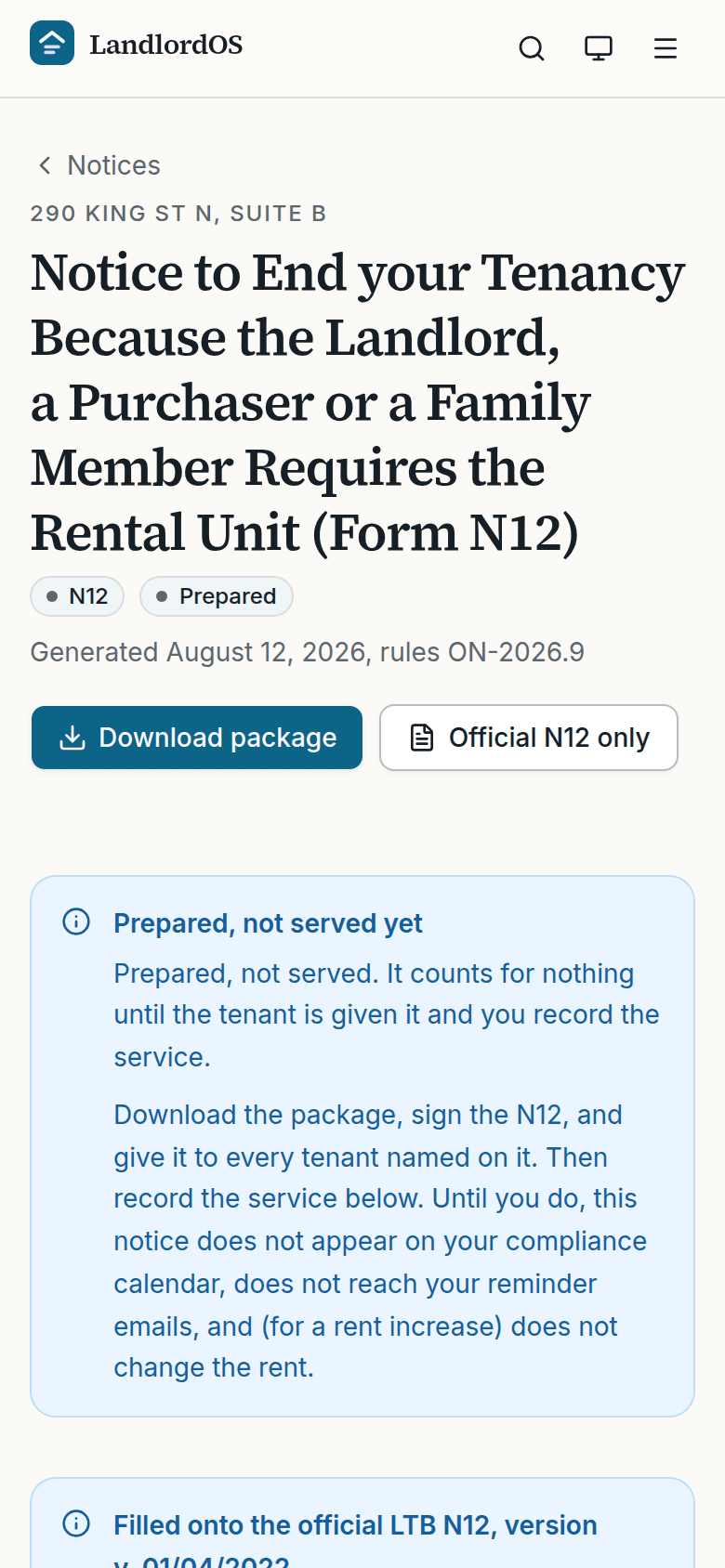
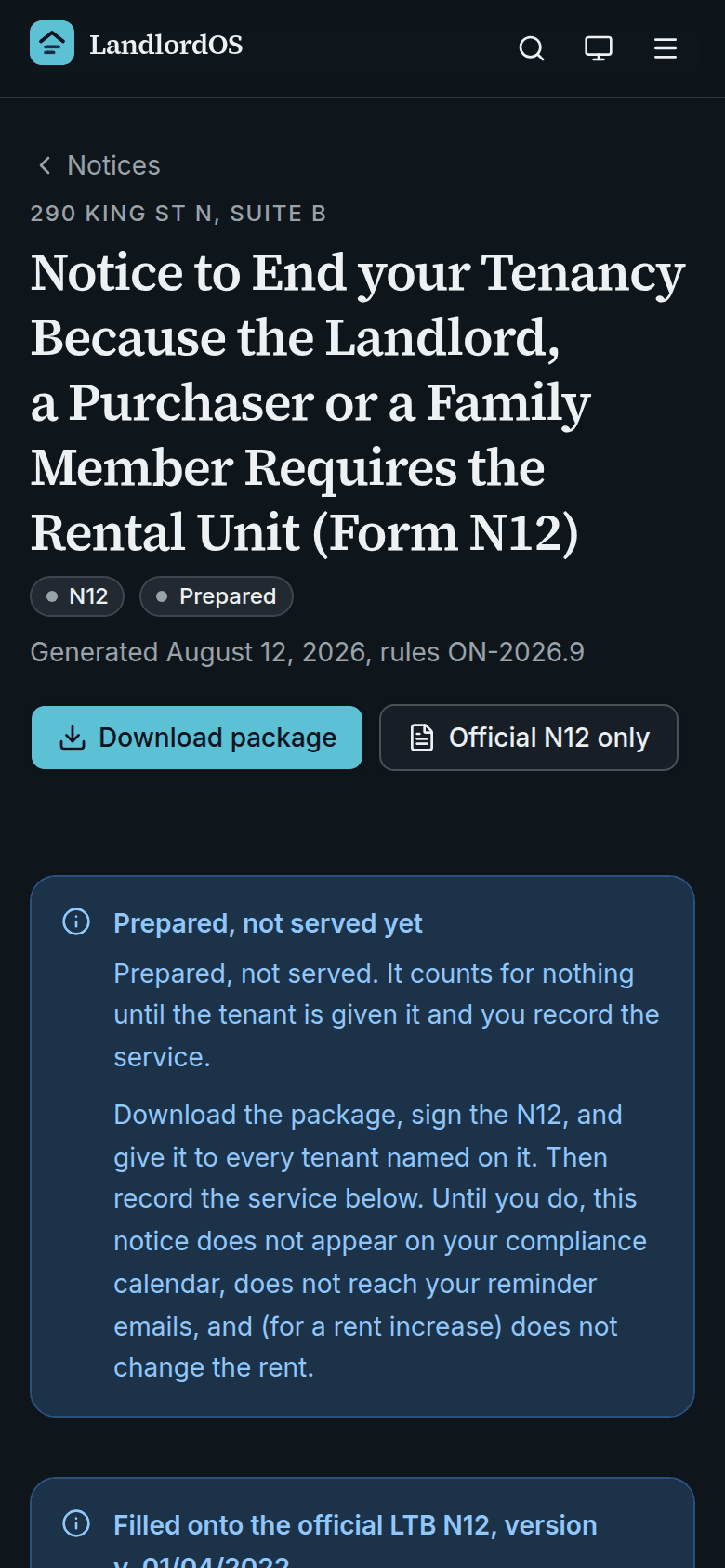
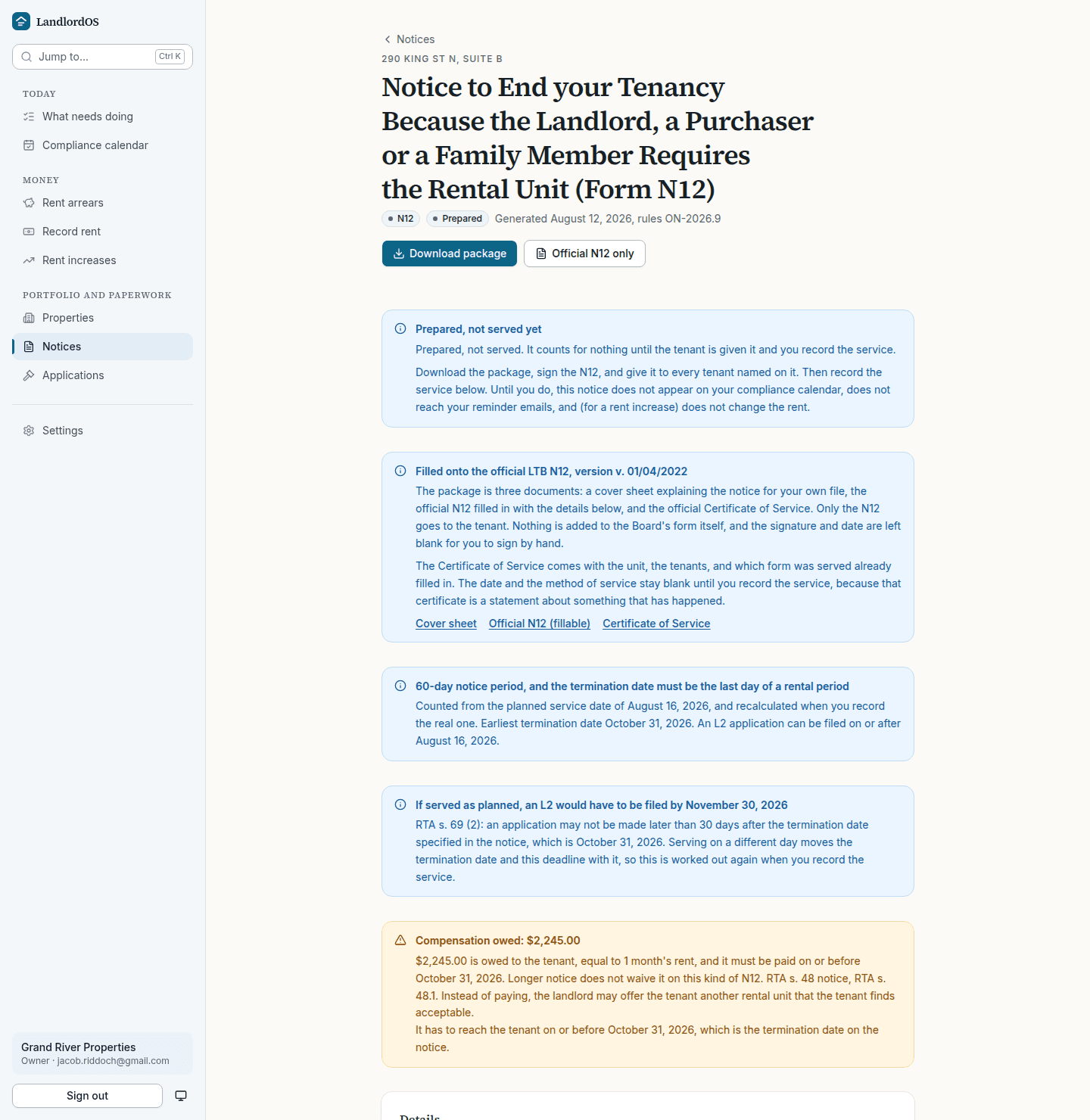
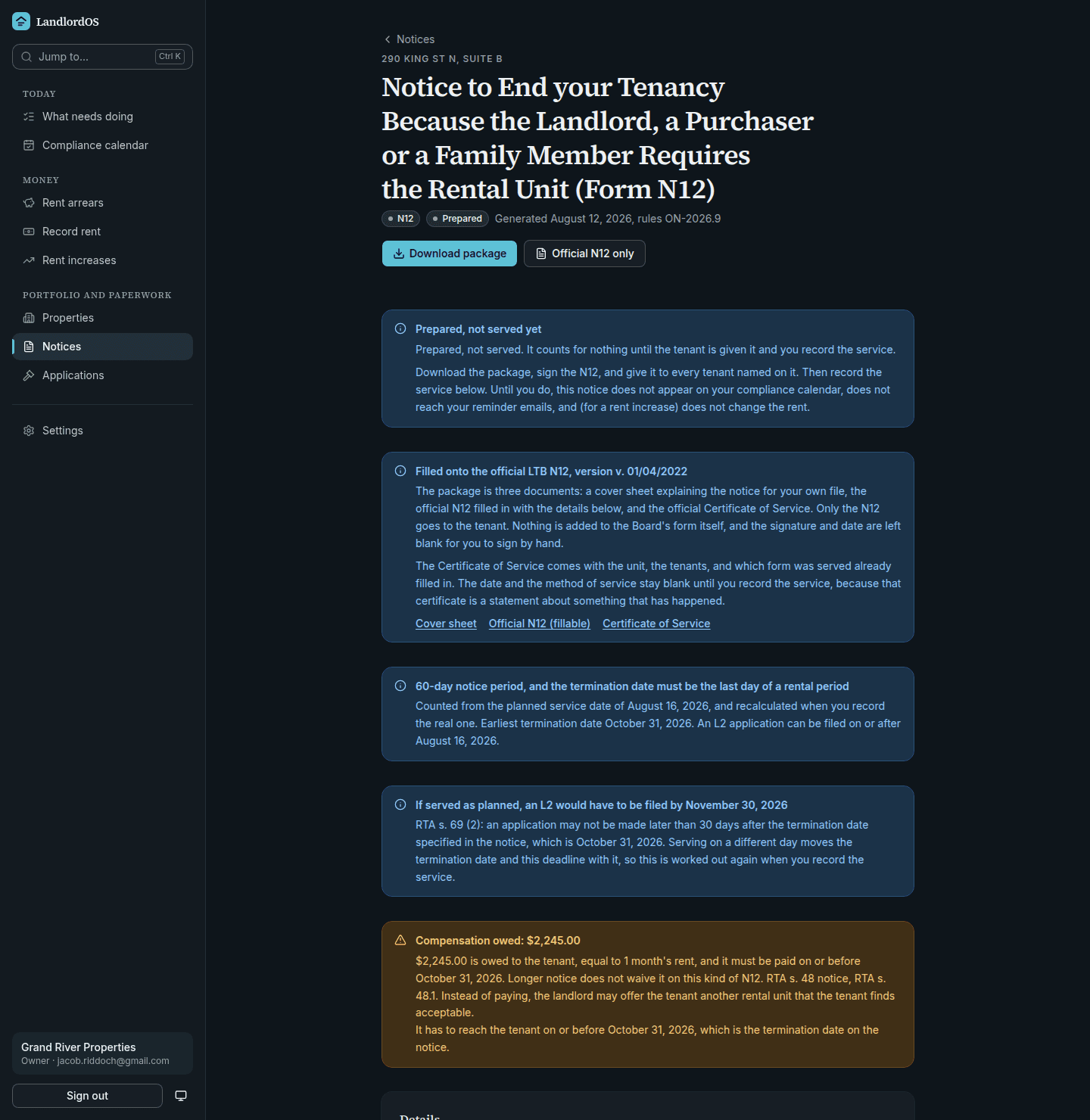
Here they are two events. A notice sits as prepared until you record who gave it to the tenant, when, and how. That is also what completes the Certificate of Service, which is a sworn statement about something that happened and should never be filled in from a plan. If the real service date falls later than the planned one, the engine runs again against what actually happened, because the same paper can stop being lawful in the four days it sat on your desk.
On a phone
Built for a phone, not shrunk onto one
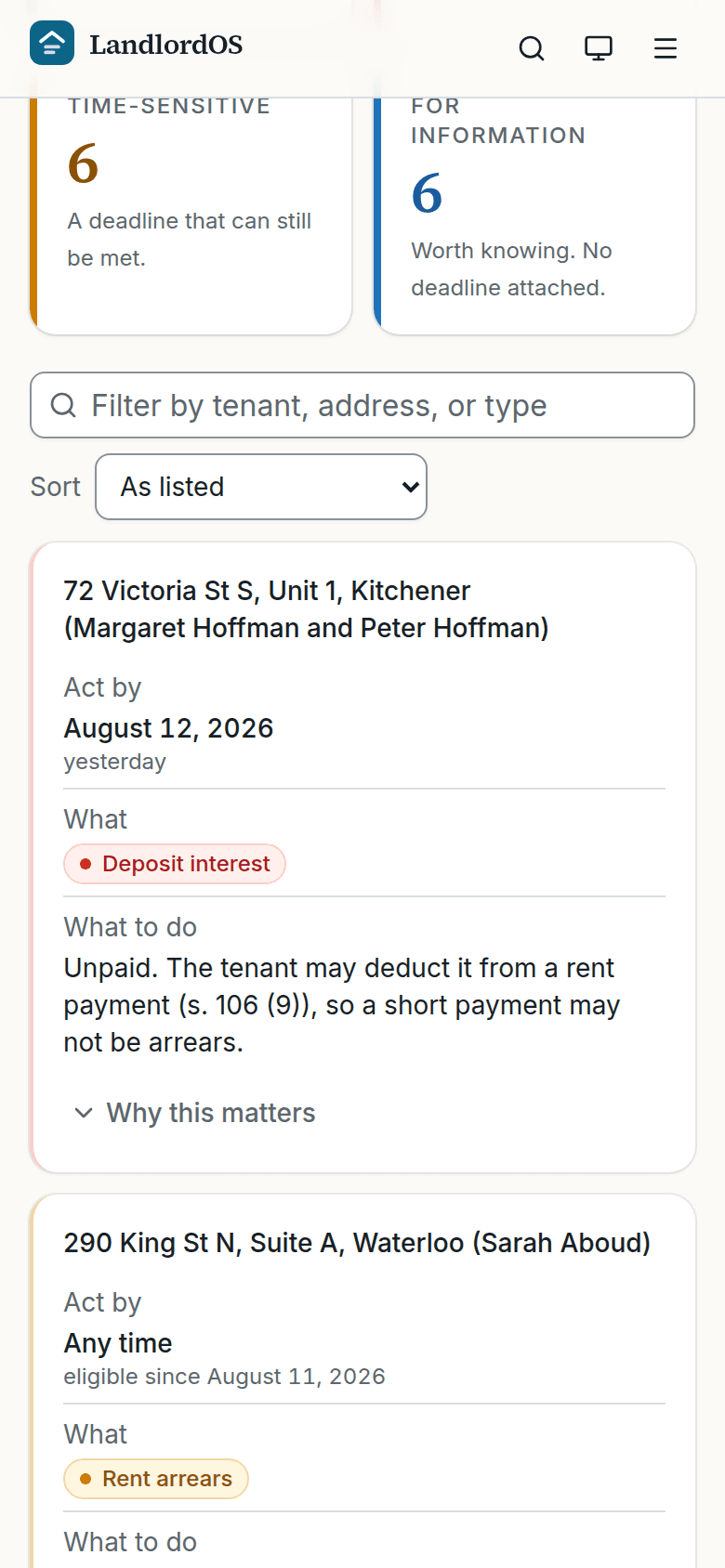
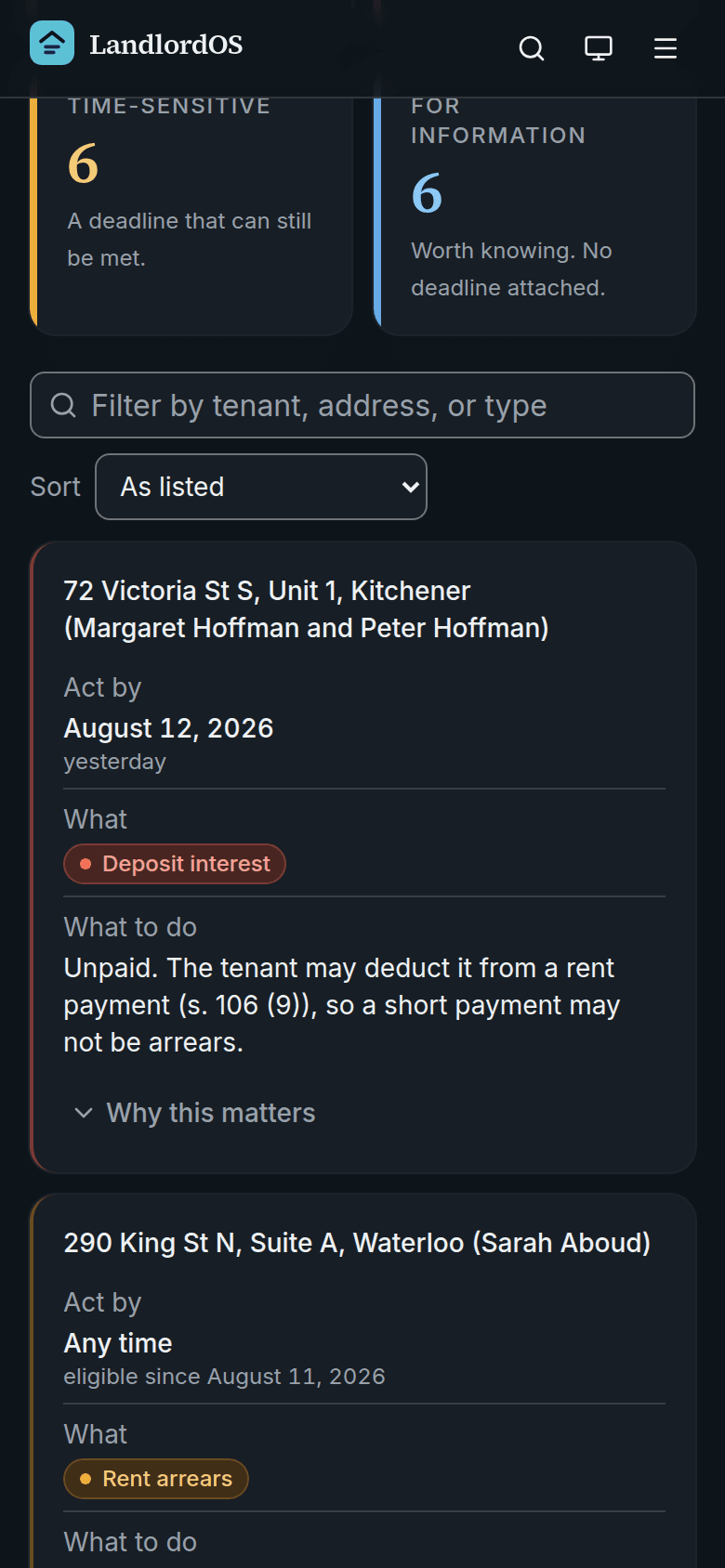
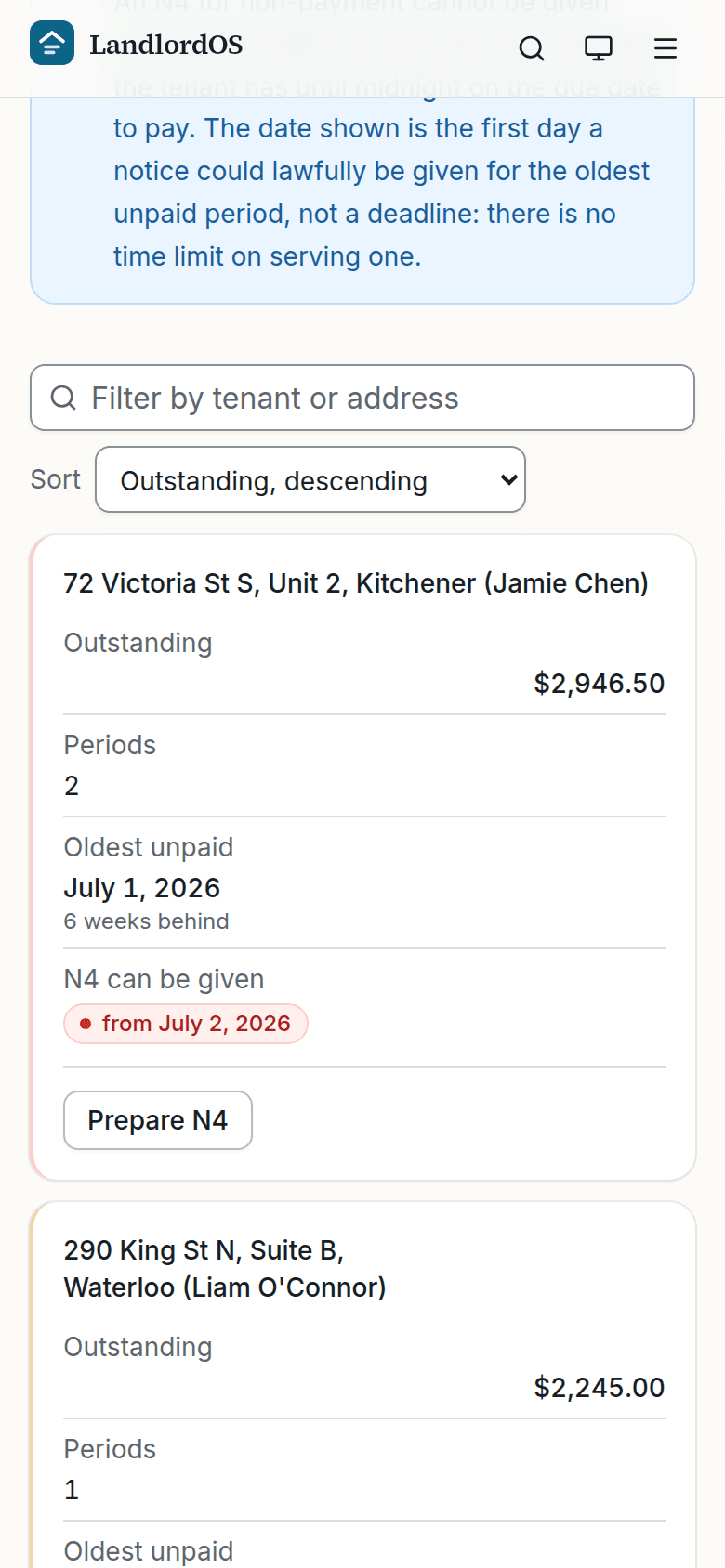
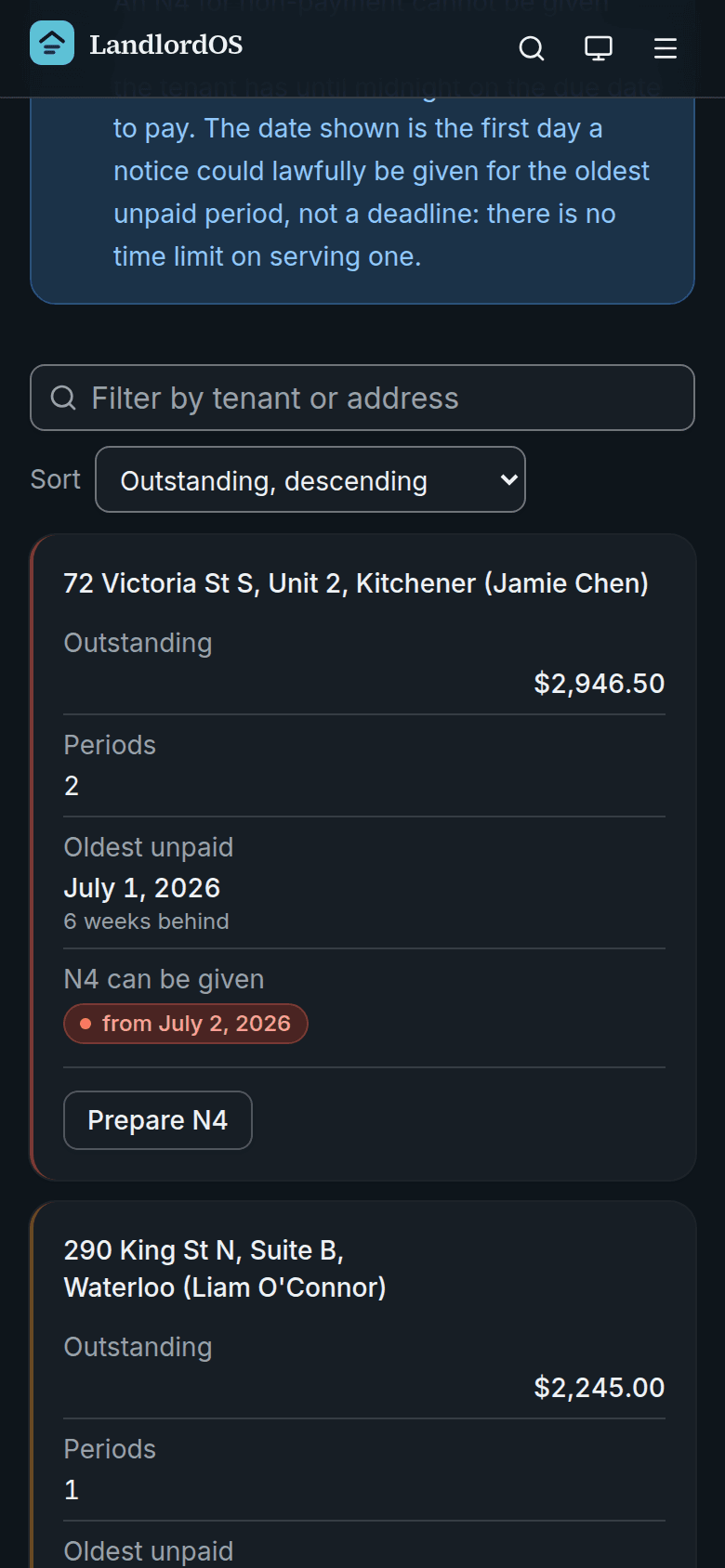
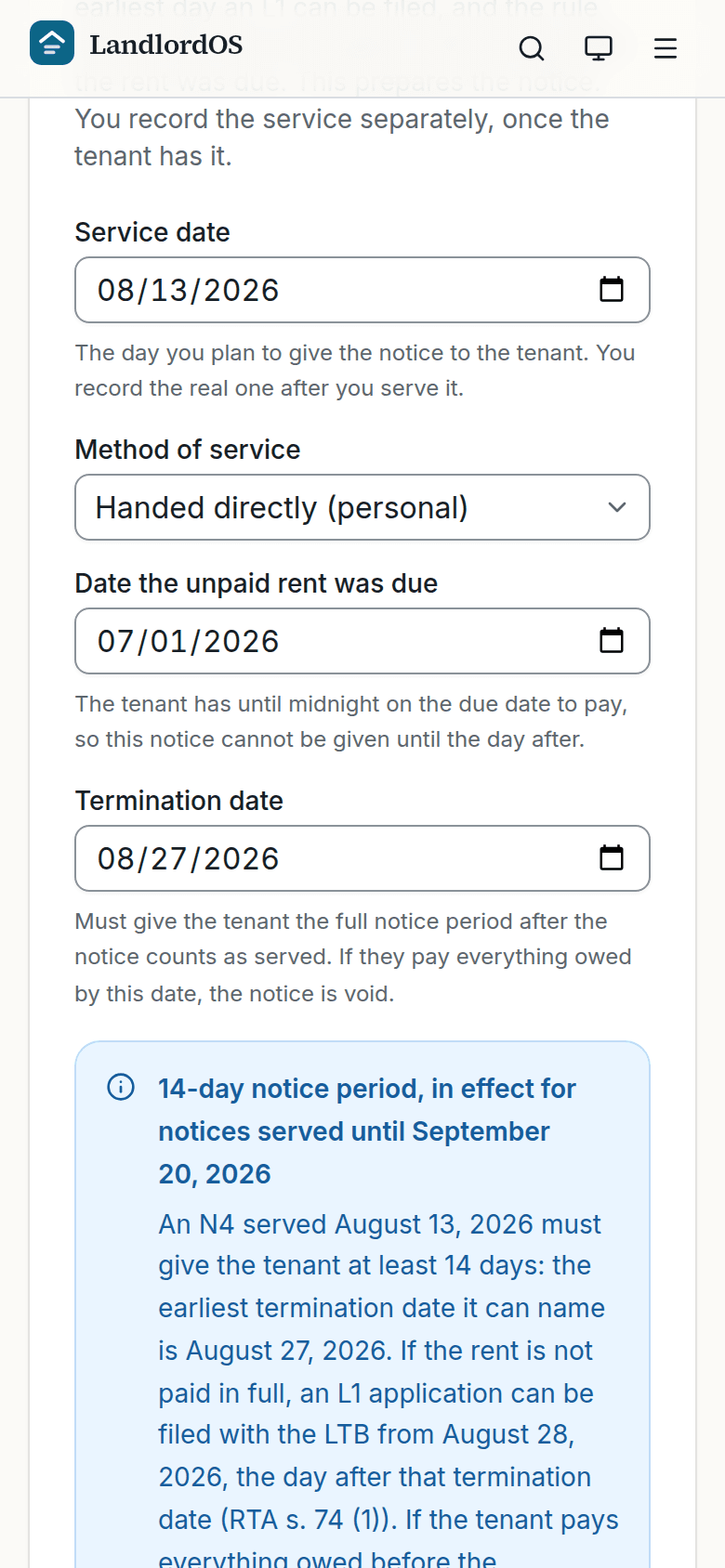
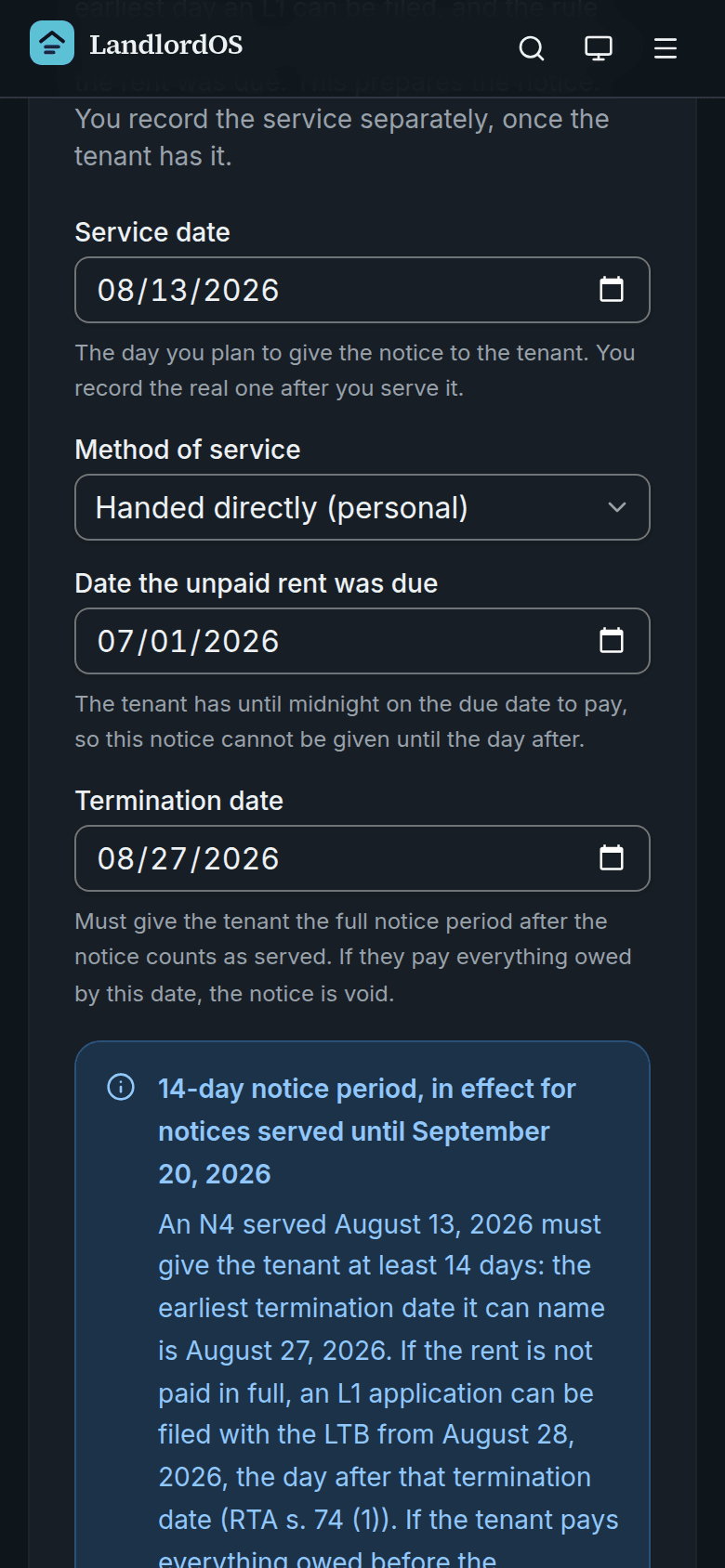
Checking a deadline usually happens standing in a hallway rather than sitting at a desk. Every screen works at 390px: tables become cards rather than scrolling sideways, and the button that resolves a row is never the thing that falls off the edge.
What Ontario changed
Ontario's N4 rules have changed
Bill 60's amendment to the N4 notice for non-payment of rent is in force, and an N4 given to a tenant today uses the 7-day notice period. A notice served before the change is still read against the rule that applied on the day it was given, which is why the date it was served matters as much as the date on the form. LandlordKit applies whichever notice period is right for the day the notice is actually served, and prints on the document which one it used and why.
7 further changes already in force
Already in force
In force since September 21, 2026N12 compensation waived on 120 days' notice
A landlord who ends a tenancy because they, a family member or a caregiver will move in owes no compensation if the notice gives 120 days or more and ends on the last day of a rental period. It reaches that notice and nothing else. One month's rent is still owed on shorter notice, on an N12 given on a purchaser's behalf (s. 49.1), and on an N13 for demolition, conversion or repairs (ss. 52 and 54), none of which this amendment touches, however long the notice period is.Source: Residential Tenancies Act s. 48.1 (2), added by 2025, c. 14, Sched. 12, s. 2 (2)
In force since September 21, 2026Set-aside test on an L3 order replaced
An eviction order made without a hearing under RTA s. 77 (4), where the tenant gave notice or the parties agreed to end the tenancy, can be set aside on the tenant's motion within 10 days (s. 77 (6)). Until this date the Board may set it aside if satisfied that it would not be unfair to do so; from this date that discretion is replaced by prescribed circumstances, conditions or tests. The 10 days and the stay of the order while the motion is pending (s. 77 (7)) are unchanged.Source: Residential Tenancies Act s. 77 (8) (b), as substituted by 2025, c. 14, Sched. 12, s. 5
In force since September 21, 2026New landlord duties on a repairs N13
Where a tenant given an N13 for repairs or renovations claims their right of first refusal to move back in, the landlord must tell them in writing, without delay, the estimated date the unit will be ready, any change to that estimate, and when it is ready, and must give them at least 60 days after it is ready to exercise the right. This is from the Helping Homebuyers, Protecting Tenants Act, 2023 rather than from Bill 60, and it happens to share a date with two Bill 60 changes.Source: Residential Tenancies Act s. 53 (2.1) and (2.2), added by 2023, c. 10, Sched. 7, s. 3
In force since July 1, 2026LTB order review deadline reduced to 15 days
The deadline to request a review of an LTB order dropped from 30 days to 15 days.Source: Tribunals Ontario operational update, June 30, 2026
In force since July 1, 2026AGI document service shortened
Above Guideline Increase supporting documents: 7-day service window with a 5-day certificate of service filing deadline.Source: Tribunals Ontario operational update, June 30, 2026
In force since July 1, 2026Mandatory Payment Agreement Form
Repayment plans between landlords and tenants must use the mandatory Payment Agreement Form.Source: Tribunals Ontario operational update, June 30, 2026
In force since July 1, 2026RTA fines doubled
Maximum fines for Residential Tenancies Act offences doubled.Source: Tribunals Ontario operational update, June 30, 2026
The dates and summaries above are read from this deployment's compliance rules data (version ON-2026.9+bundle:ON-2026.12), the same versioned table the app calculates notice dates from, so they cannot drift apart. Sources are named on each item.
The compensation change is narrower than you have read
Bill 60 waives the month's rent a landlord owes a tenant on an N12, but only on 120 days' notice, and only on one of the reasons a person can give an N12 for. It is reported almost everywhere as covering N12 and N13 notices alike. It does not. Getting this wrong in the generous direction means withholding money you owe.
WaivedN12: You, your family, or a caregiver moving in
Nothing owed on 120 days' notice or more, if the notice ends on the last day of a rental period. One month's rent on anything shorter.RTA s. 48.1 (2), added by 2025, c. 14, Sched. 12, s. 2 (2)
OwedN12: A purchaser, or the purchaser's family, moving in
One month's rent, or another unit the tenant accepts, however long the notice period is. The waiver does not reach this one.RTA s. 49.1
OwedN13: Demolition, conversion, or repairs needing the unit empty
3 months' rent where the complex has five or more residential units, one month where it has fewer, or another unit the tenant accepts. An N13 has to give at least 120 days anyway, so it can look as though the waiver applies. It never does.RTA s. 52 (1), and RTA s. 54 for repairs
N12 compensation waived on 120 days' notice
A landlord who ends a tenancy because they, a family member or a caregiver will move in owes no compensation if the notice gives 120 days or more and ends on the last day of a rental period. It reaches that notice and nothing else. One month's rent is still owed on shorter notice, on an N12 given on a purchaser's behalf (s. 49.1), and on an N13 for demolition, conversion or repairs (ss. 52 and 54), none of which this amendment touches, however long the notice period is.
Source: Residential Tenancies Act s. 48.1 (2), added by 2025, c. 14, Sched. 12, s. 2 (2)
LandlordKit computes the position for the notice in front of you, states the dollar amount, and prints the section it came from. It is the same rules data the app uses to work out the date on the form, which is why this page cannot claim something the product does not do. Rules version ON-2026.9+bundle:ON-2026.12.
What it costs
Start free, pay for the size you are
Every plan has every feature. The only thing that changes is how many tenancies it covers, because the compliance engine is the same code whether it runs once or fifty times. Two months free when billed yearly.
Starter
$29CAD a month
5 tenancies. A house, a duplex, a small triplex.
Or $290 a year.
PortfolioMost portfolios
$49CAD a month
20 tenancies. A small building, or several small ones.
Or $490 a year.
Professional
$99CAD a month
50 tenancies. The largest portfolio the product is built for.
Or $990 a year.
In every plan, including the free one
- Every notice type the product supports, on the official Board forms
- The L1, L2 and L3 applications, with the portal companion
- The compliance engine on every date, with the reasoning written out
- Rent ledger, arrears, and rent receipts
- The audit trail: a frozen snapshot behind every notice
- Daily reminders when something is genuinely due
- Unlimited properties, units, and team members
What it does not do
- No card is taken and no account is charged today
- Ontario only. The rules encoded here are the Residential Tenancies Act's
- No rent collection or payment processing. Payments are entered by hand
Before you ask
The questions that decide it
Nothing here is a compliance answer. These are questions about the product, and the answers are the ones that would come back if you emailed.
Does it collect rent?
No. No rent is collected, held, or moved, and it never will be. Payments are recorded by a person agreeing that money arrived, and every arrears figure, N4 table and receipt is built on those rows.
What happens if I stop paying?
The account becomes read only. You keep reading everything, downloading any notice already served, recording that a notice was served, keeping the ledger accurate, and exporting the lot. What stops is preparing a new notice.
Where is my data held?
The application and the database both run in Canada, in the Montreal region. The privacy policy says exactly what that does and does not amount to, rather than turning it into a claim about the law.
Is it only for Ontario?
Yes, and that is the point. The engine encodes the Residential Tenancies Act: guideline percentages by year, notice periods, deemed service, compensation. None of it transfers to another province, so none of it is written to.
What if the rules change?
They are versioned data rather than code, so a new guideline or a proclaimed amendment is published without a deploy. Every notice records the rules version it was computed under, so an old document stays reproducible.
How big a portfolio?
The free plan covers 1, and the paid plans go up to 50. Reaching a plan's limit stops you adding a NEW tenancy and stops nothing else: everything already on the account carries on in full, every notice, every download and the export included. Past the largest plan, get in touch and we will sort out the right price at that size.
Not ready to sign up?
Leave an address and we will write when an Ontario rule changes in a way that costs landlords money, and when the product does something it did not do before. Nothing else.