Press and brand kit
Everything on this page is generated from the product
The price comes from the pricing module, the form counts from the vendored manifest of Board forms, the name and the contact from the identity module. A sentence here cannot go on describing an offer that has moved or a form the product does not fill, which is the whole reason it is a page rather than a document somebody keeps up to date.
Descriptions
Three lengths, one claim
A directory listing takes sixty characters, a social bio about a hundred and sixty, a press release opener a sentence. Writing each one fresh is how three descriptions of one product stop agreeing.
- Short
Ontario landlord compliance software
- Medium
Ontario landlord compliance: 10 official Landlord and Tenant Board forms, every date computed from the Residential Tenancies Act, and the rule behind each one shown.
- Long
LandlordKit is compliance software for small landlords, 1 to 50 units in Ontario, Canada. It fills the Board's own approved forms rather than lookalikes, computes every notice date from a tested engine that prints the rule it came from, tracks rent and arrears, and keeps an audit trail that survives a rules change. Free for one tenancy. Paid plans from $29 a month, up to 50 tenancies.
- Boilerplate
LandlordKit is compliance software for small landlords, 1 to 50 units in Ontario, Canada. It fills the Board's own approved forms rather than lookalikes, computes every notice date from a tested engine that prints the rule it came from, tracks rent and arrears, and keeps an audit trail that survives a rules change. Free for one tenancy. Paid plans from $29 a month, up to 50 tenancies. It provides forms and information, never legal advice: every output tells the reader to confirm with the Landlord and Tenant Board or a licensed paralegal or lawyer.
- Positioning
A generic property manager stores your leases. This works out whether the notice you are about to serve is lawful, on the day you are about to serve it, and shows the section it read to decide.
Claims
Every claim, and where to check it
The entire pitch of this product is that its dates are right, so a promotional claim nobody can trace is the exact thing it exists to replace. Each one names the module or the statute section that proves it.
The Board's own 6 notice forms and 4 applications, filled in, not redrawn.
Prooflib/official-forms.ts, generated from the vendored manifest at assets/ltb-forms/manifest.json. Each notice snapshot freezes the form version and checksum it was filled onto.
Every date shows the rule that produced it, including which N4 notice period applied and why.
Proofpackages/compliance-engine returns noticePeriodDescription with every N4 timeline, and every surface that shows a date shows it.
Bill 60's compensation waiver reaches a landlord's own-use N12 and nothing else. It never reaches an N13.
Proof2025, c. 14, Sched. 12, s. 2 (2) amends RTA s. 48.1 alone. ss. 49.1, 52 and 54 carry no amendment from that chapter. Encoded as date-ranged rows in rules_table and printed on the public page from that table.
Preparing a notice and serving it are two separate events, and the engine runs again at service.
Proofnotice_record.served_at is what every downstream consumer requires, and the second verdict is frozen into service_snapshot beside the first.
Rent deposit interest is tracked, because an unpaid year of it can arrive as short rent and look exactly like arrears.
ProofRTA s. 106 (6) and s. 106 (9). The engine reports the possible shortfall on every surface where an N4 can be started, and never quietly reduces the arrears figure.
Nothing you type into the public N4 calculator leaves your browser.
Proofcomponents/marketing/n4-calculator.tsx runs the compliance engine client side. There is no endpoint, so there is nothing to log and nothing to rate limit.
An unpaid subscription degrades to read only and never locks you out of your own evidence.
ProofEntitlement.canRead and canExport are typed as the literal true, so a branch blocking them does not compile. billing-boundary.test.ts pins the eight gated call sites, all of them preparing a NEW document.
The product never touches a tenant's money.
ProofNon-negotiable rule 4. Stripe takes the landlord's subscription on a page Stripe hosts; Plaid reads one bank account, read only, and suggests. Every rent_payment row is written by a person agreeing to an allocation.
Guardrails
What is never claimed, and why
Read this before writing the stronger version
Legal advice, legal opinion, or any wording implying a lawyer reviewed a specific situation.
The product provides forms and information. Non-negotiable rule 1, and every compliance output carries the disclaimer saying so.
The only tool that handles Ontario.
It held for Buildium, TurboTenant and Avail and no longer holds generally: Ontario-specific competitors exist. Say what a generic tool structurally cannot do instead.
Guaranteed compliance, or a notice that cannot be challenged.
The engine computes dates and checks a notice against the rules on file. A tribunal decides whether a notice is good.
Verified rent, confirmed deposits, or anything implying the product checked that money arrived.
A confirmed payment is not a verified one. confirmed_at means a person agreed to an allocation, and nothing in this product has ever checked a bank balance.
Canadian hosting satisfies PIPEDA.
Compute runs in Canada and the privacy policy says so, and then says in as many words that it is not claiming a legal test is met. legal.test.ts fails if that turns into a compliance claim.
Pricing
The published plans
- Free: up to one tenancy, no card, no expiry.
- Starter: $29 a month, up to 5 tenancies.
- Portfolio: $49 a month, up to 20 tenancies.
- Professional: $99 a month, up to 50 tenancies.
- Two months free on any annual plan. The entry paid price is $29 a month and the largest published plan covers 50 tenancies.
- No feature is held back from a smaller landlord. Tiers are priced by active tenancies and nothing else.
Ready to send
Posts, generated the same way
Written for somebody who already knows what an N4 is, because that is who the blog audience the founder already has. The numbers in them come from the rules table, so a post cannot quote a notice period the engine no longer computes.
- The calculator, as the hookX
Ontario's N4 notice period drops from 14 days to 7 for notices served from 2026-09-21. Most of what you will find online still says 14. Free N4 date calculator, no account, nothing leaves your browser: landlordkit.ca
- The correction nobody else is makingX
Bill 60 waives the N12 compensation at 120 days. It does not touch the N13, and an N13 has to give 120 days anyway, so every N13 looks like it qualifies and none does. RTA s. 48.1 (2) amends s. 48.1 alone.
- Positioning, for a professional audienceLinkedIn
A generic property manager stores your leases. This works out whether the notice you are about to serve is lawful, on the day you are about to serve it, and shows the section it read to decide. Ontario landlord compliance: 10 official Landlord and Tenant Board forms, every date computed from the Residential Tenancies Act, and the rule behind each one shown. Free for one tenancy. Paid plans from $29 a month, up to 50 tenancies.
- To the blog list, on the Bill 60 changeEmail subject
The N4 notice period changes on 2026-09-21, and your template still says 14 days
- Opening paragraph for a guest post or newsletterBlog lede
A generic property manager stores your leases. This works out whether the notice you are about to serve is lawful, on the day you are about to serve it, and shows the section it read to decide. LandlordKit is compliance software for small landlords, 1 to 50 units in Ontario, Canada. It fills the Board's own approved forms rather than lookalikes, computes every notice date from a tested engine that prints the rule it came from, tracks rent and arrears, and keeps an audit trail that survives a rules change. Free for one tenancy. Paid plans from $29 a month, up to 50 tenancies.
Assets
All of them generated
Nothing here was exported from a design tool. A saved PNG is the one surface that cannot follow a palette change, and the social card is the most-seen brand asset because it is what a link to the blog renders as.
The mark
/icon.svgA case whose handle is a roofline. Geometry lives in lib/brand-mark.ts and a test holds icon.svg to the same numbers.
Social card
/opengraph-image1200x630, generated per request from the same manifest the PDF filler reads, so vendoring a form updates the card in the same commit.
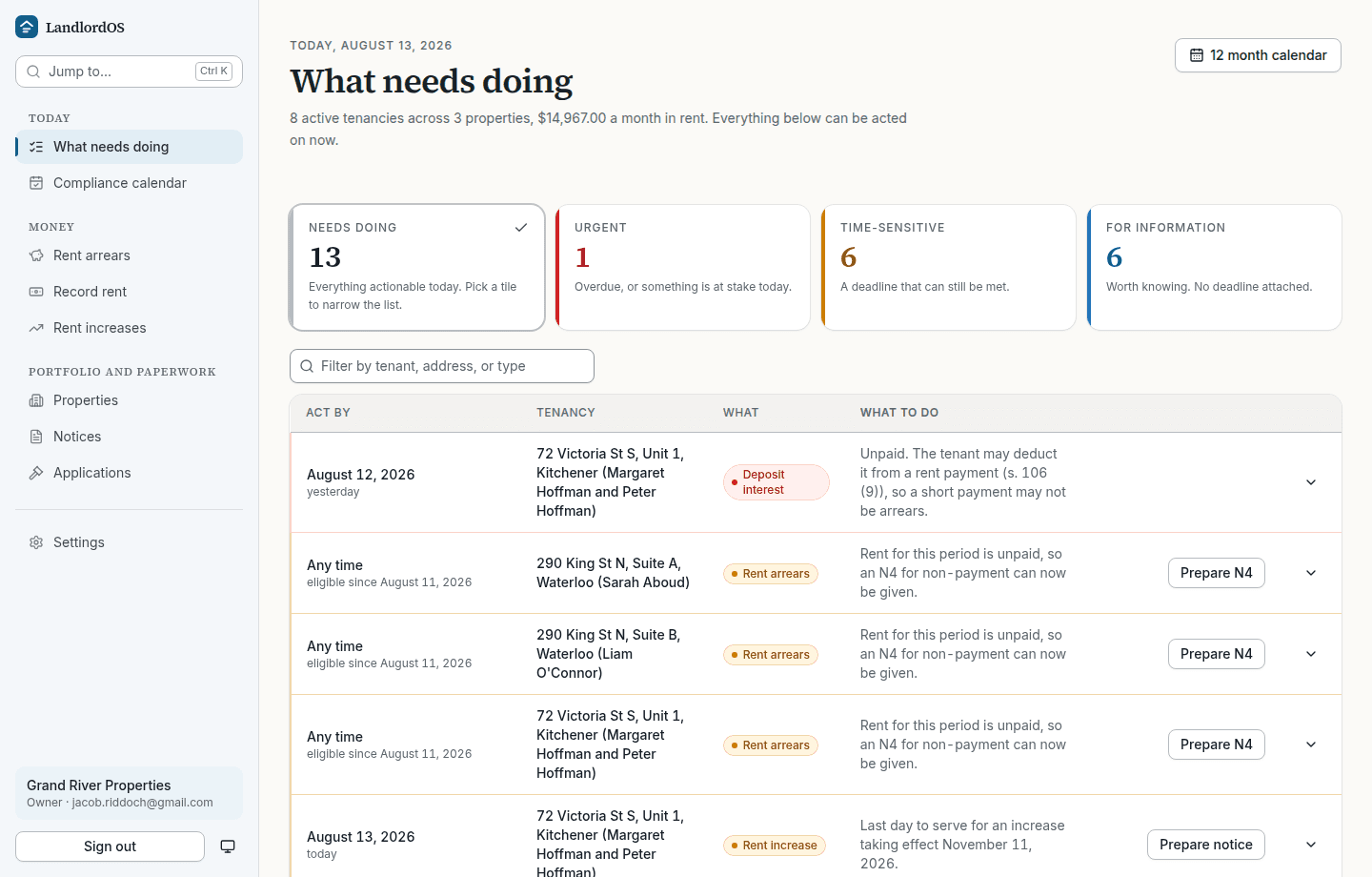
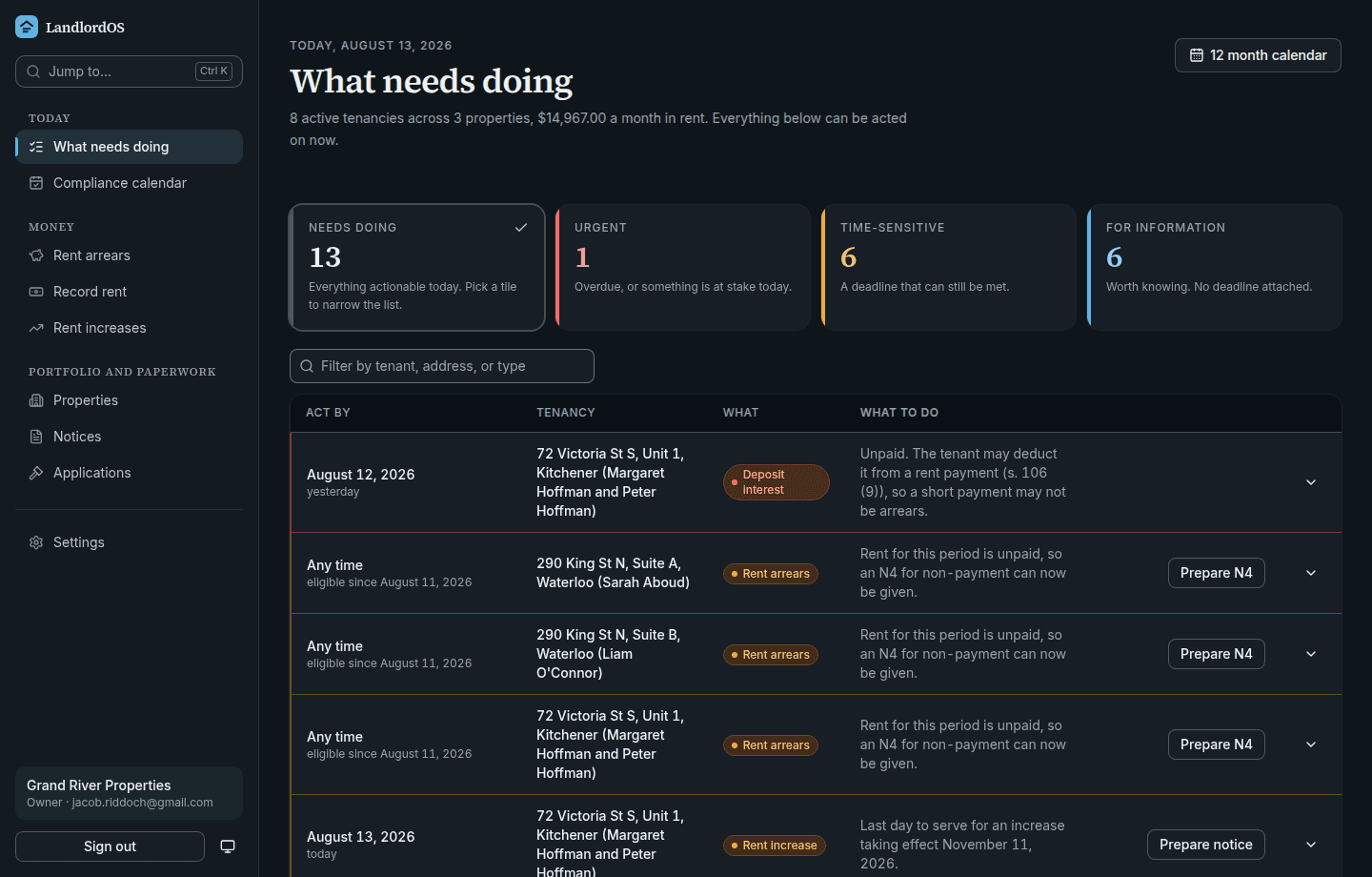
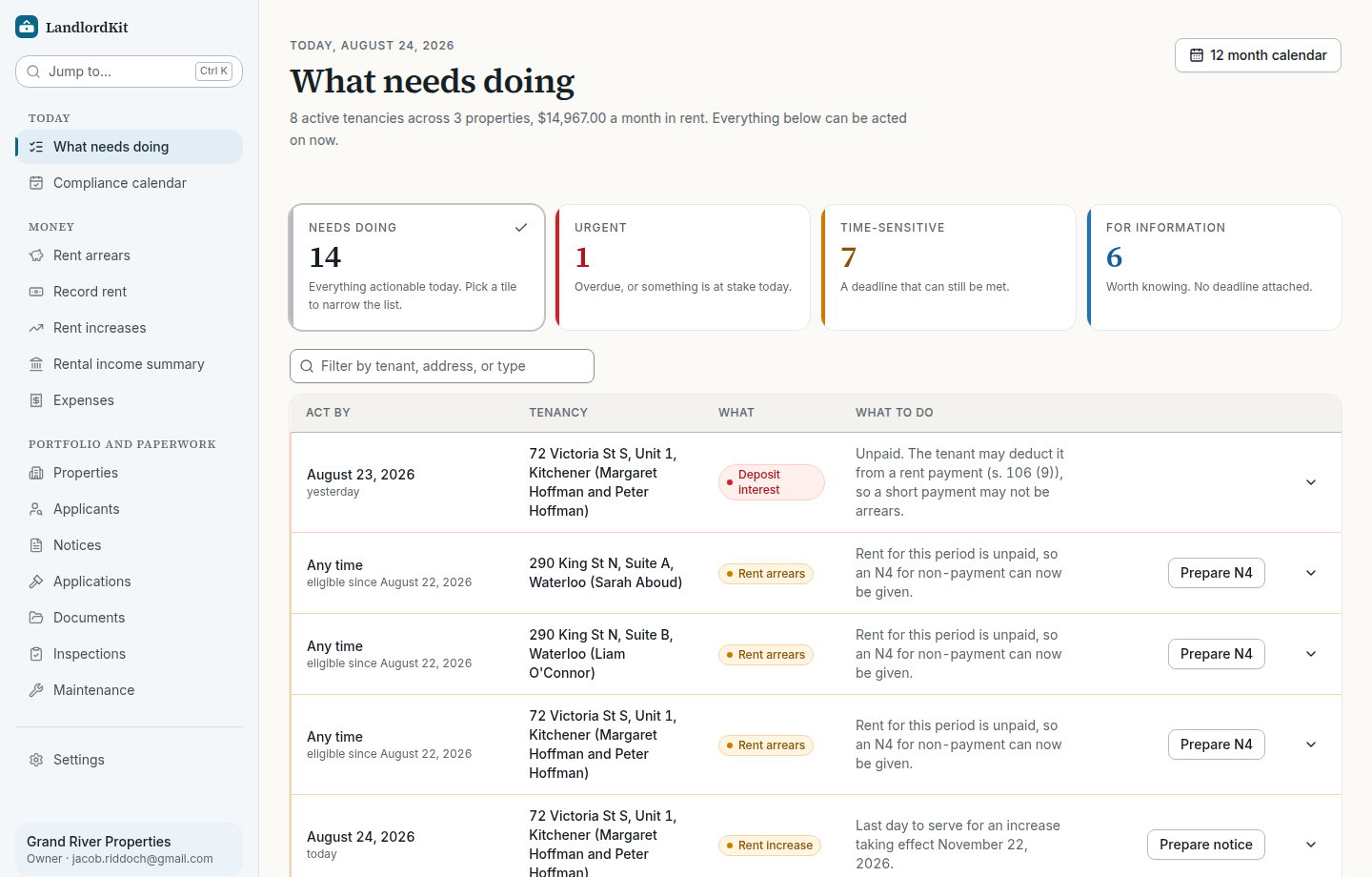
Everything actionable today, most urgent first, with the action that resolves it on the row.
/product/dashboard-wide-light.pngReal capture of the seeded demo at 1440px. Fictional tenants, which is the only reason it may be published.
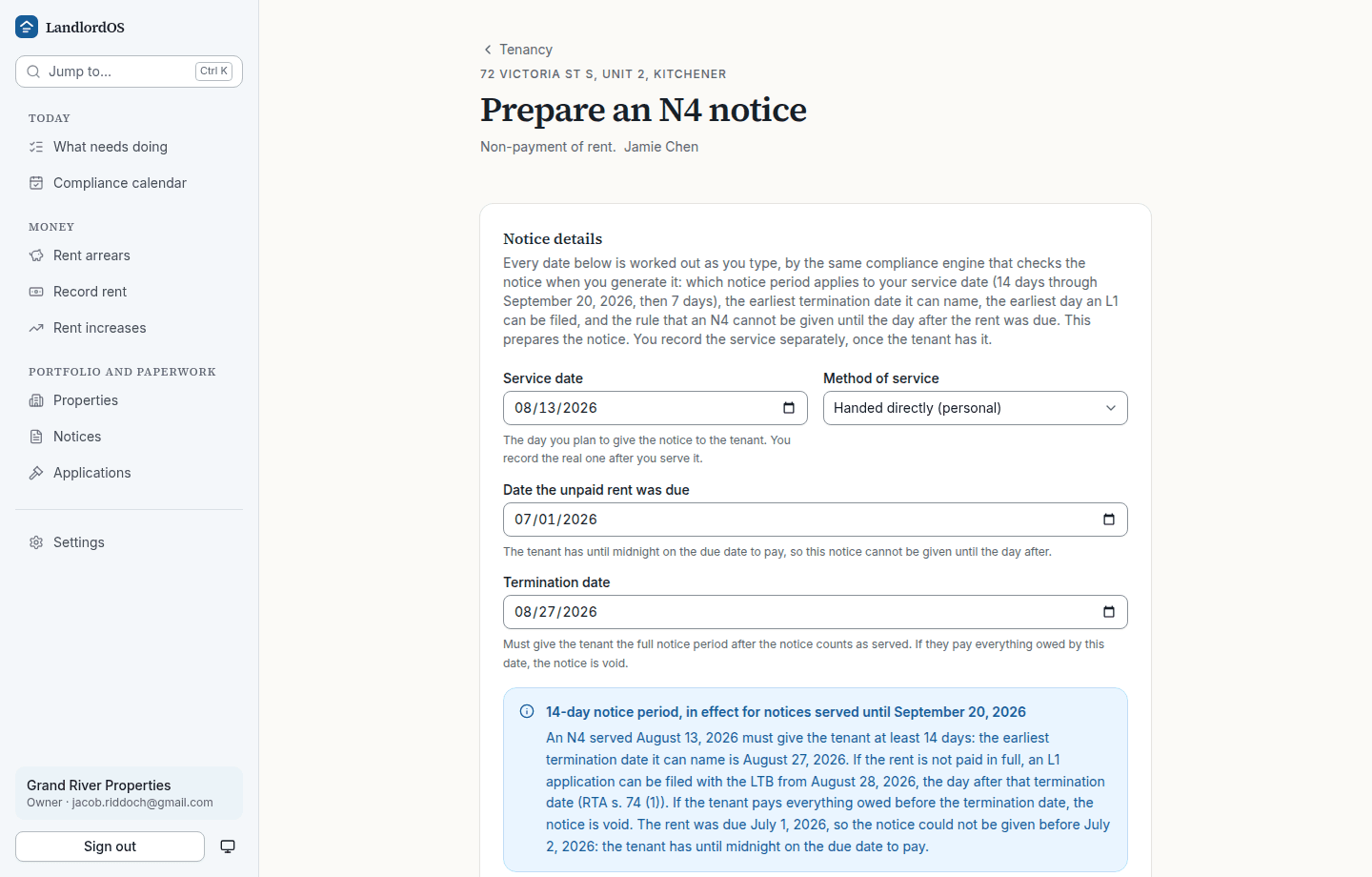
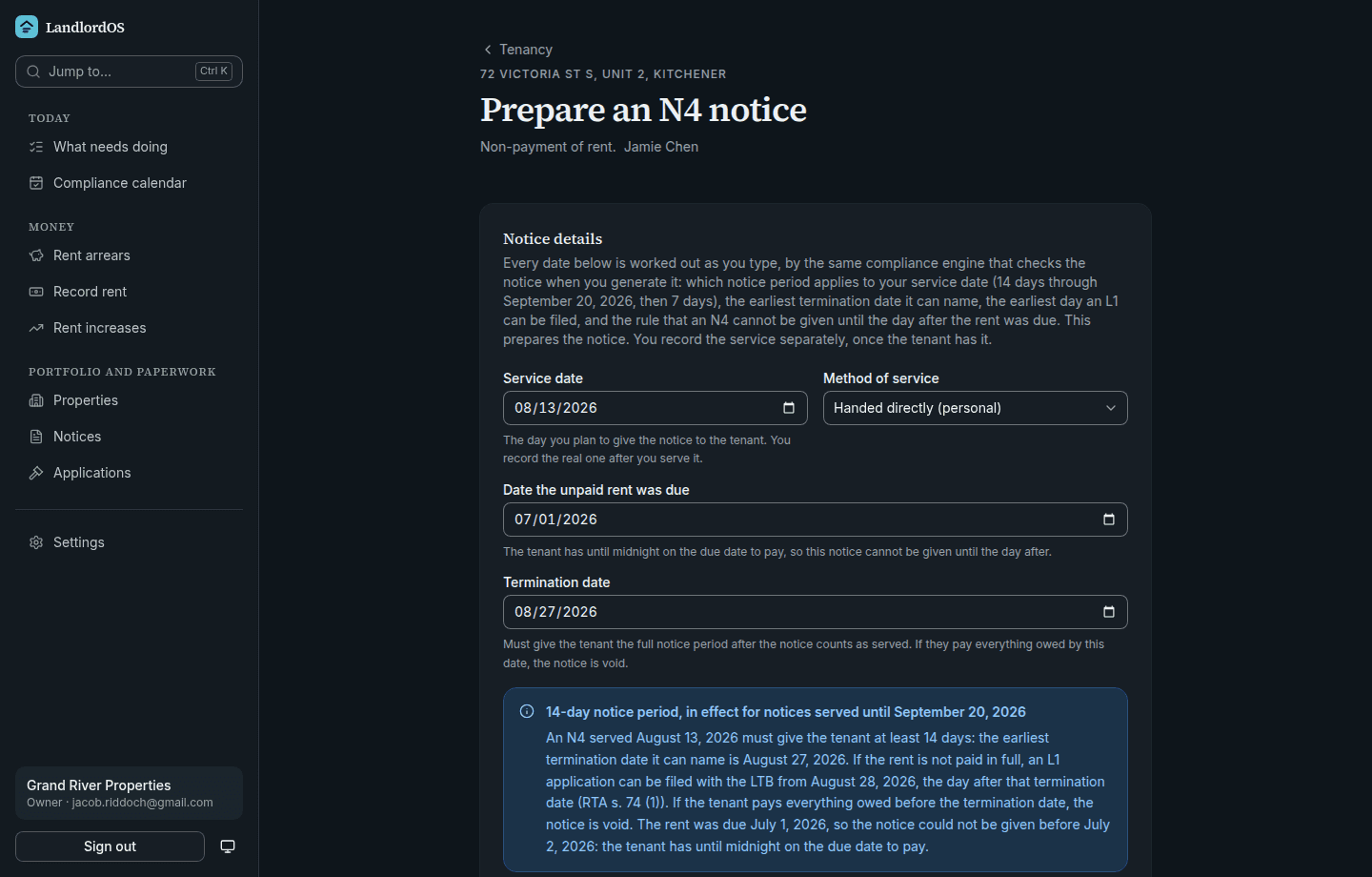
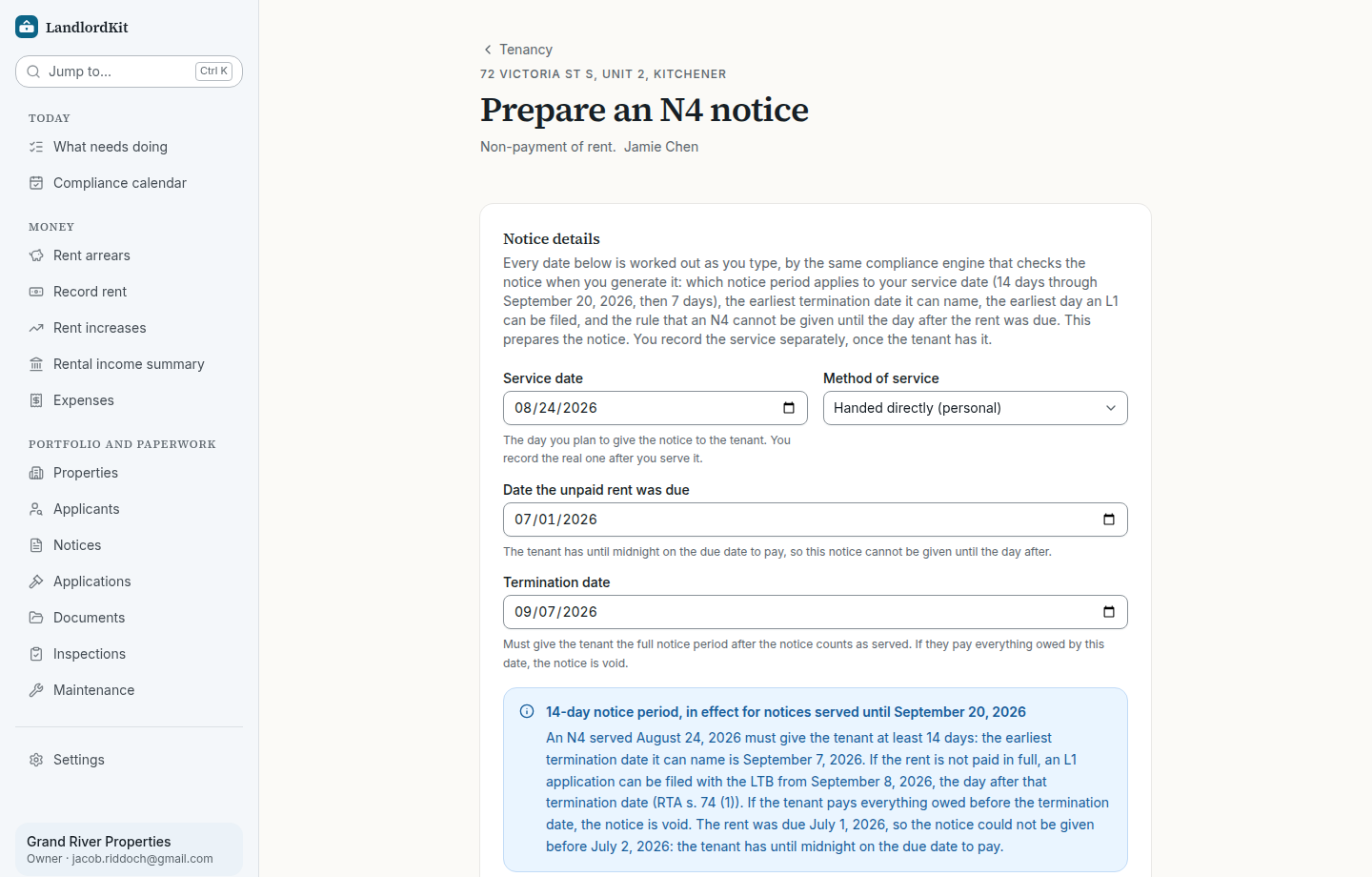
The engine recalculates while you type, and writes out which rule produced the date.
/product/n4-form-wide-light.pngReal capture of the seeded demo at 1440px. Fictional tenants, which is the only reason it may be published.
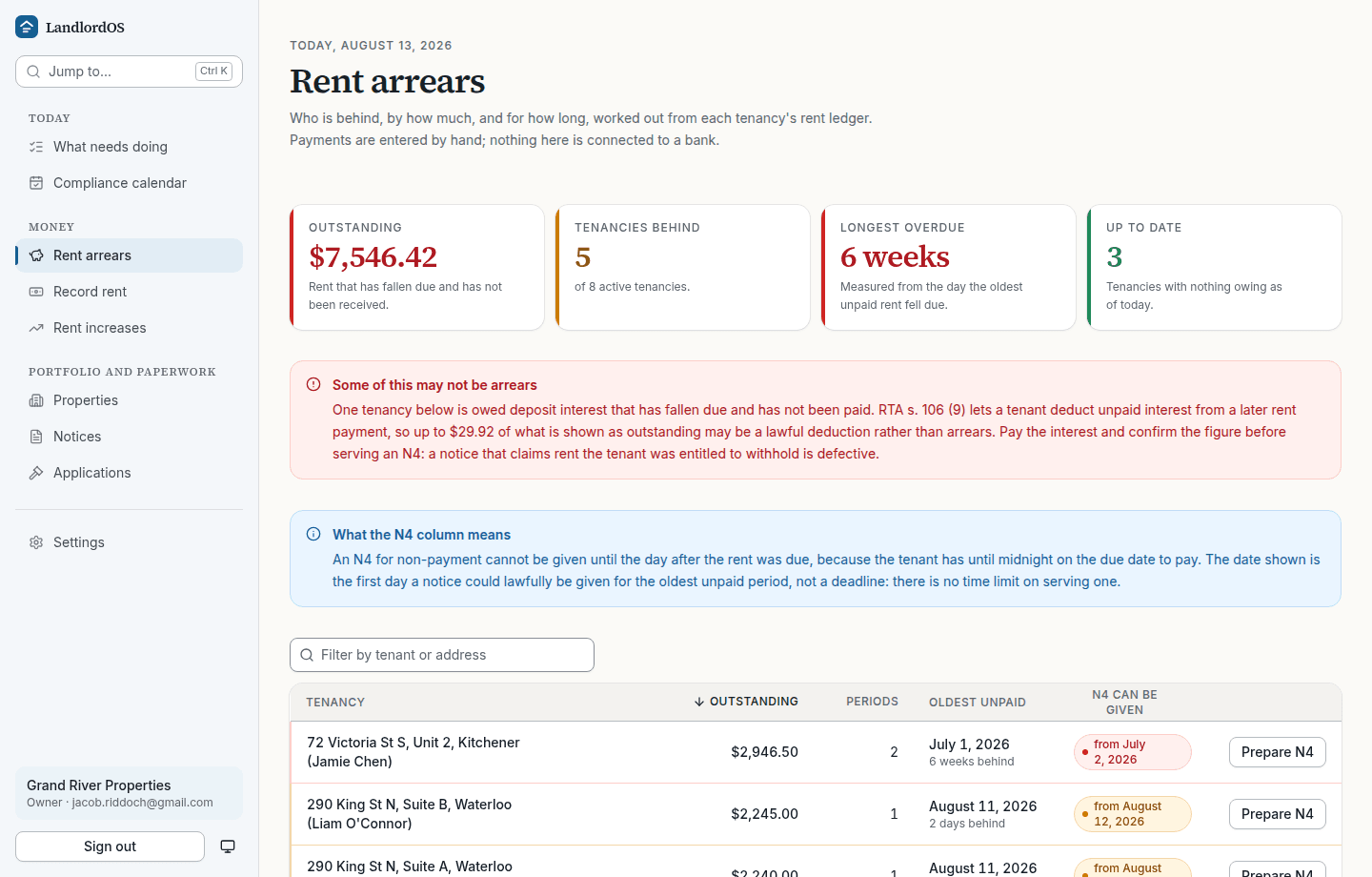
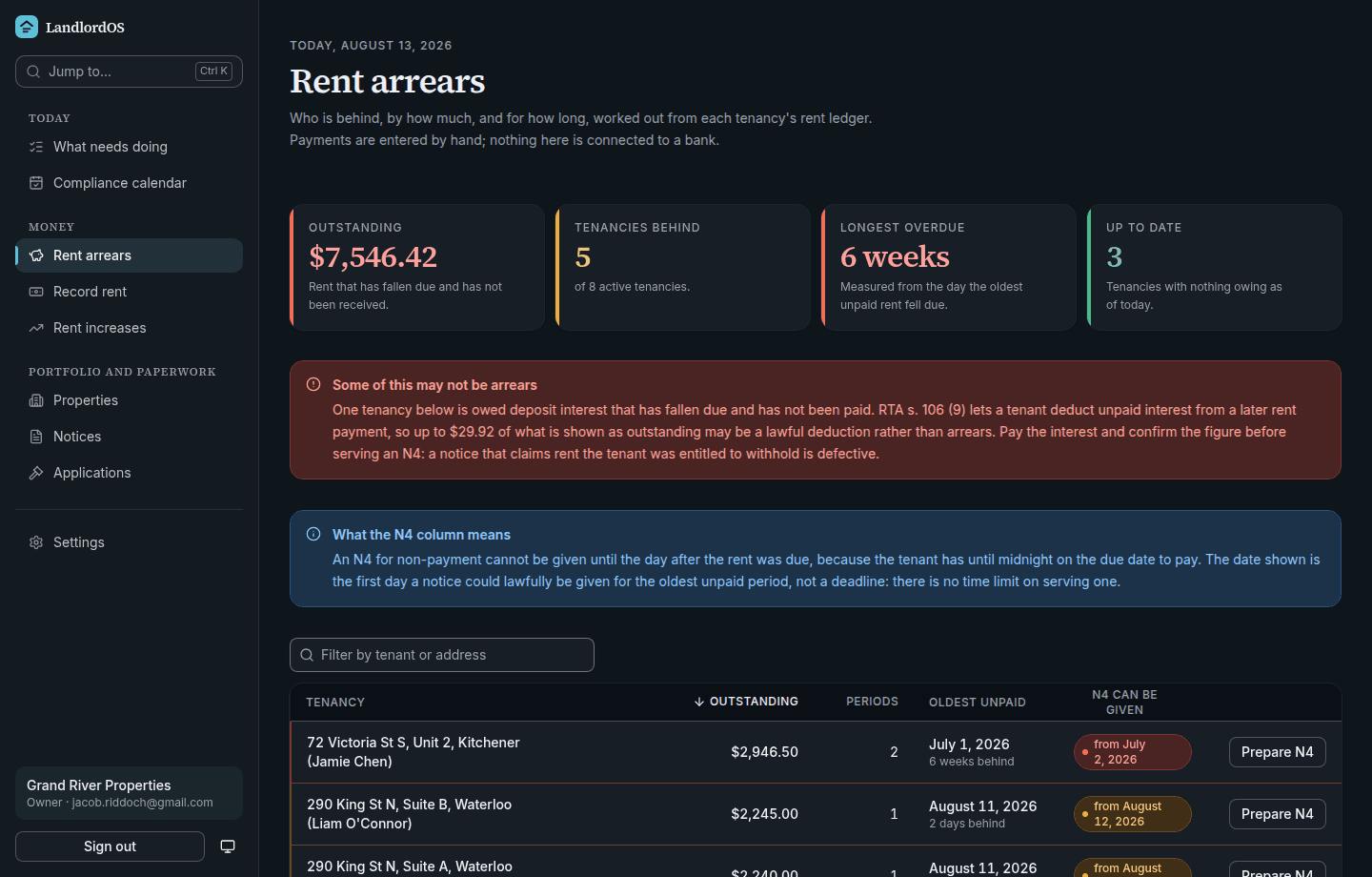
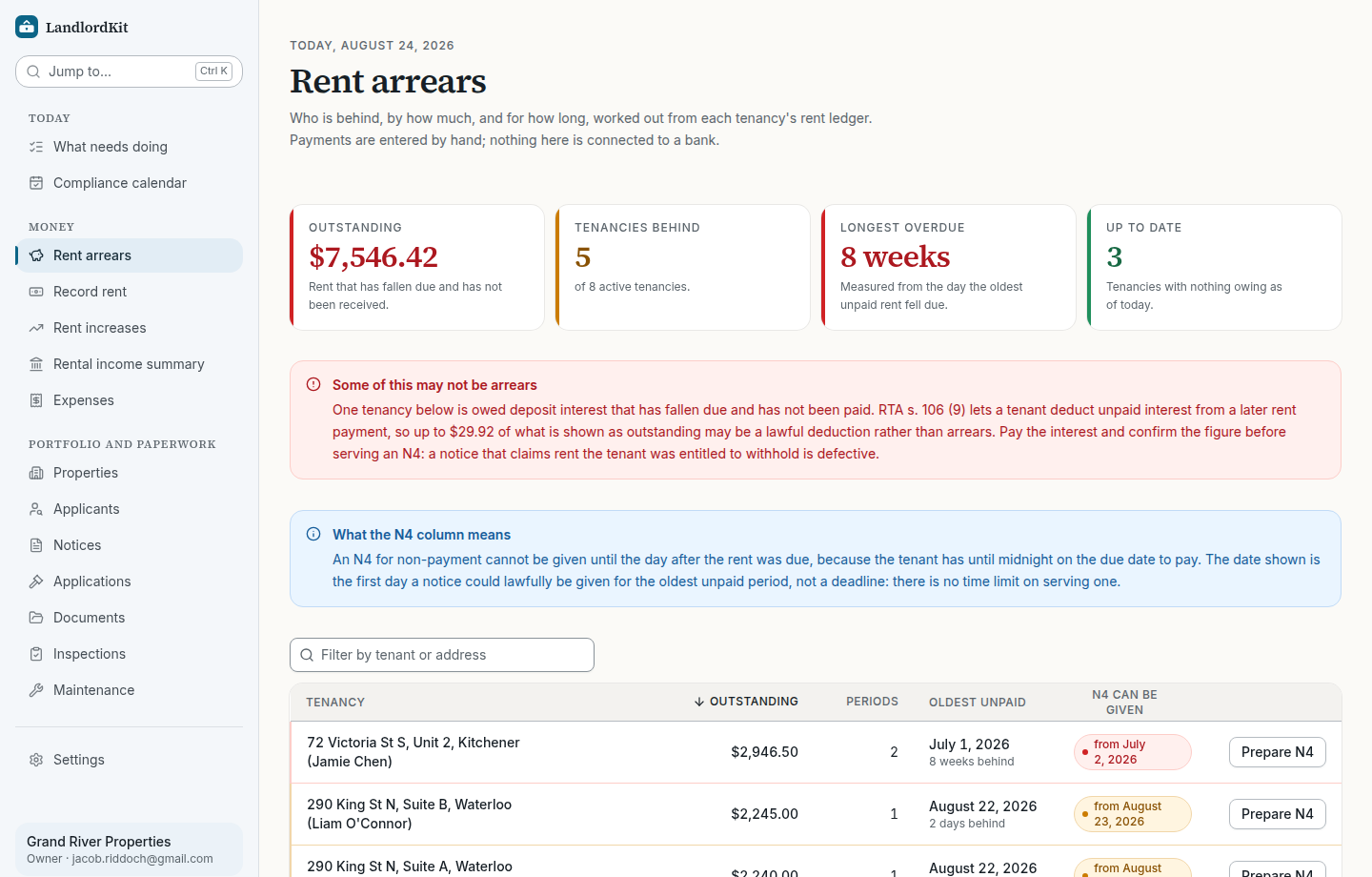
Who is behind, by how much, and the first day an N4 could lawfully be given for it.
/product/arrears-wide-light.pngReal capture of the seeded demo at 1440px. Fictional tenants, which is the only reason it may be published.
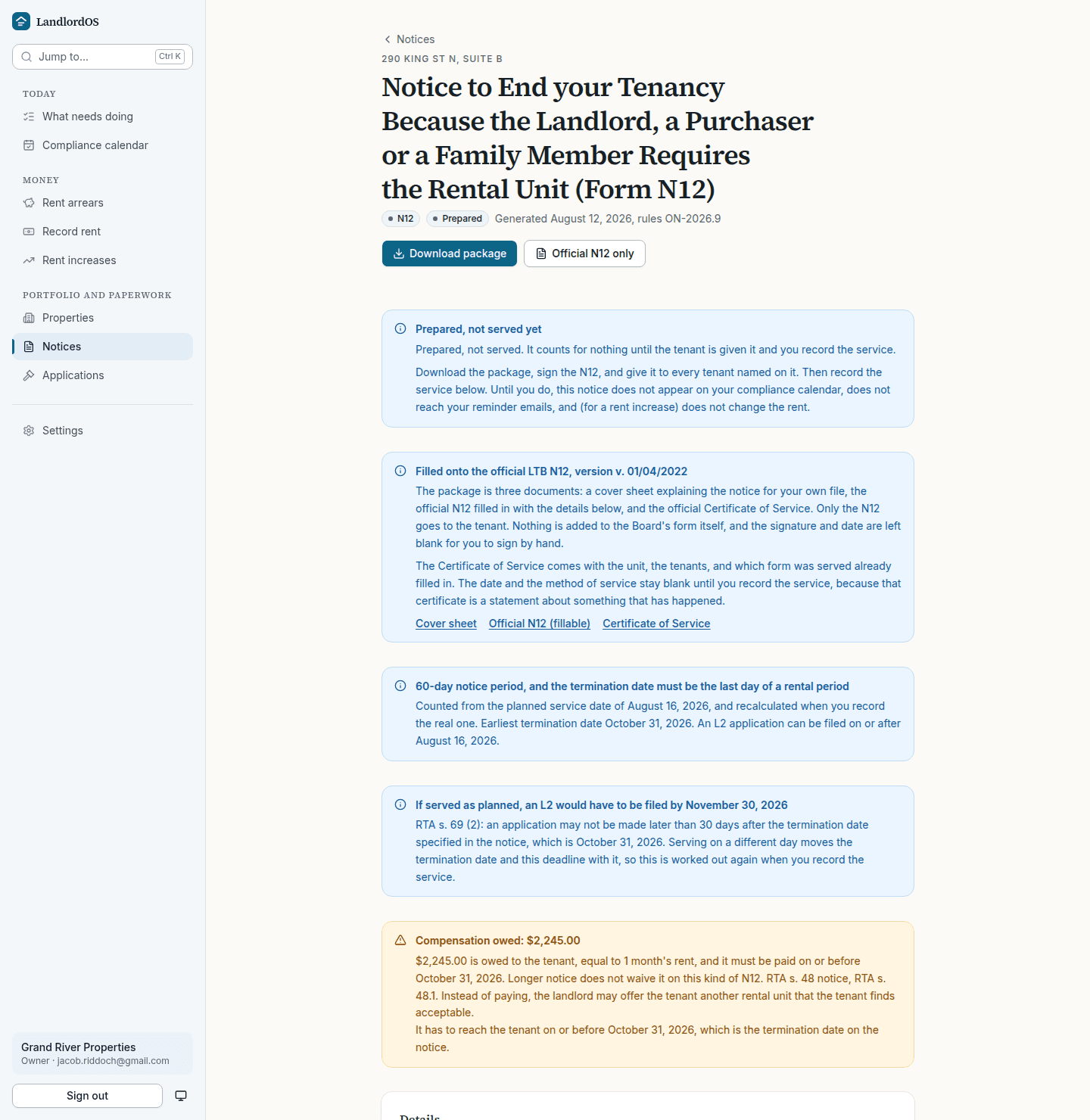
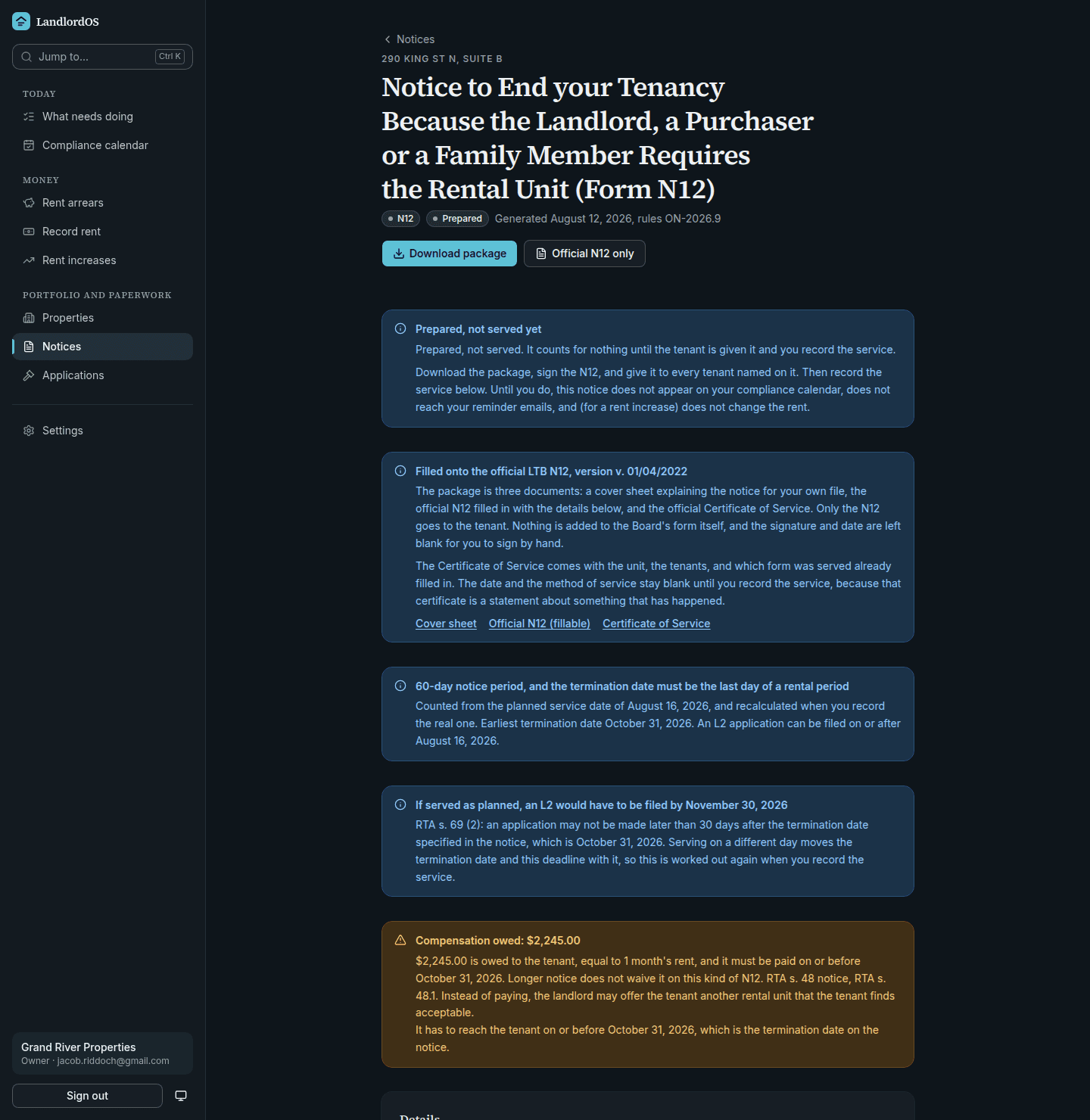
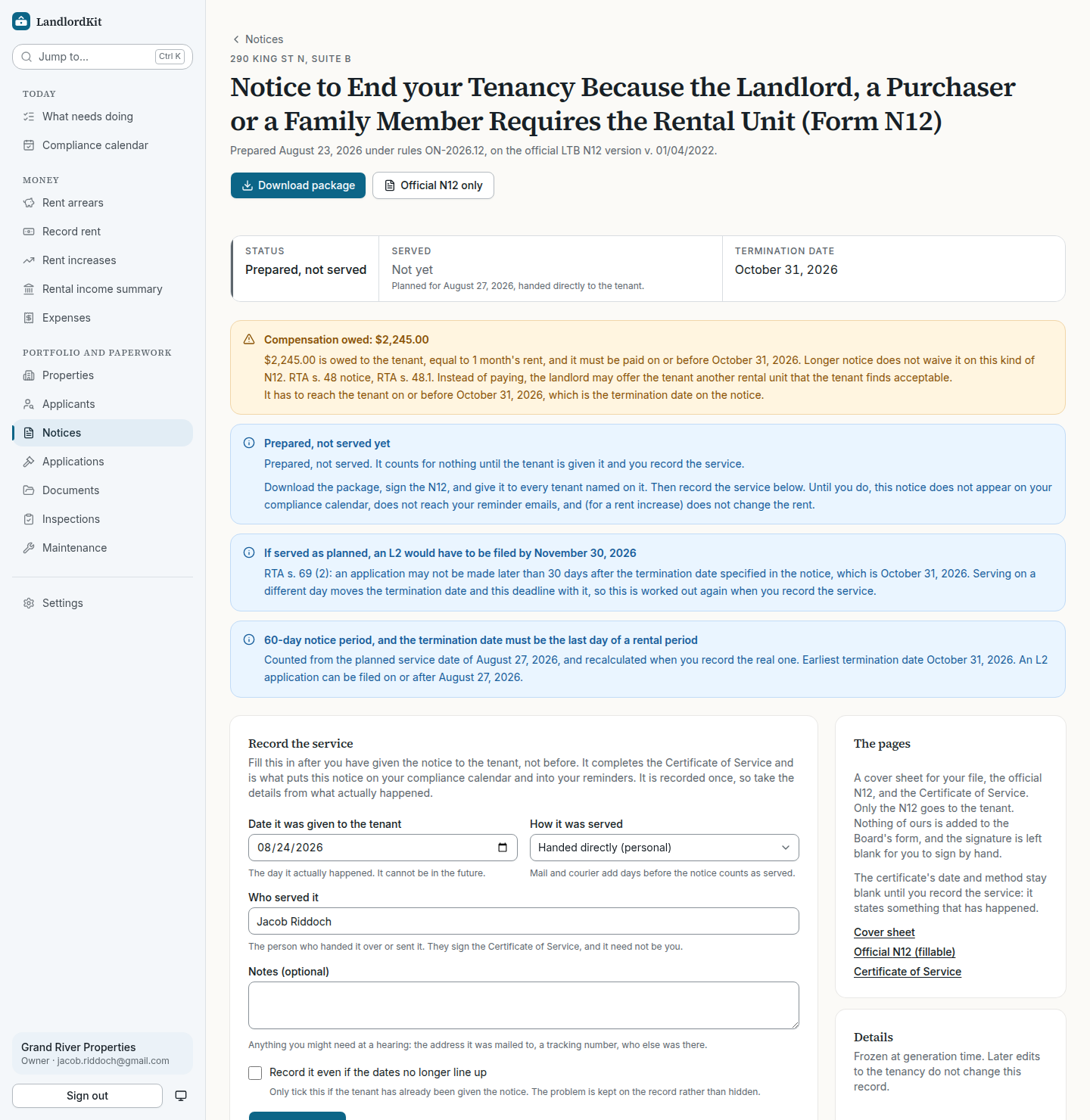
Prepared is not served. Until the service is recorded the notice counts for nothing.
/product/notice-n12-wide-light.pngReal capture of the seeded demo at 1440px. Fictional tenants, which is the only reason it may be published.
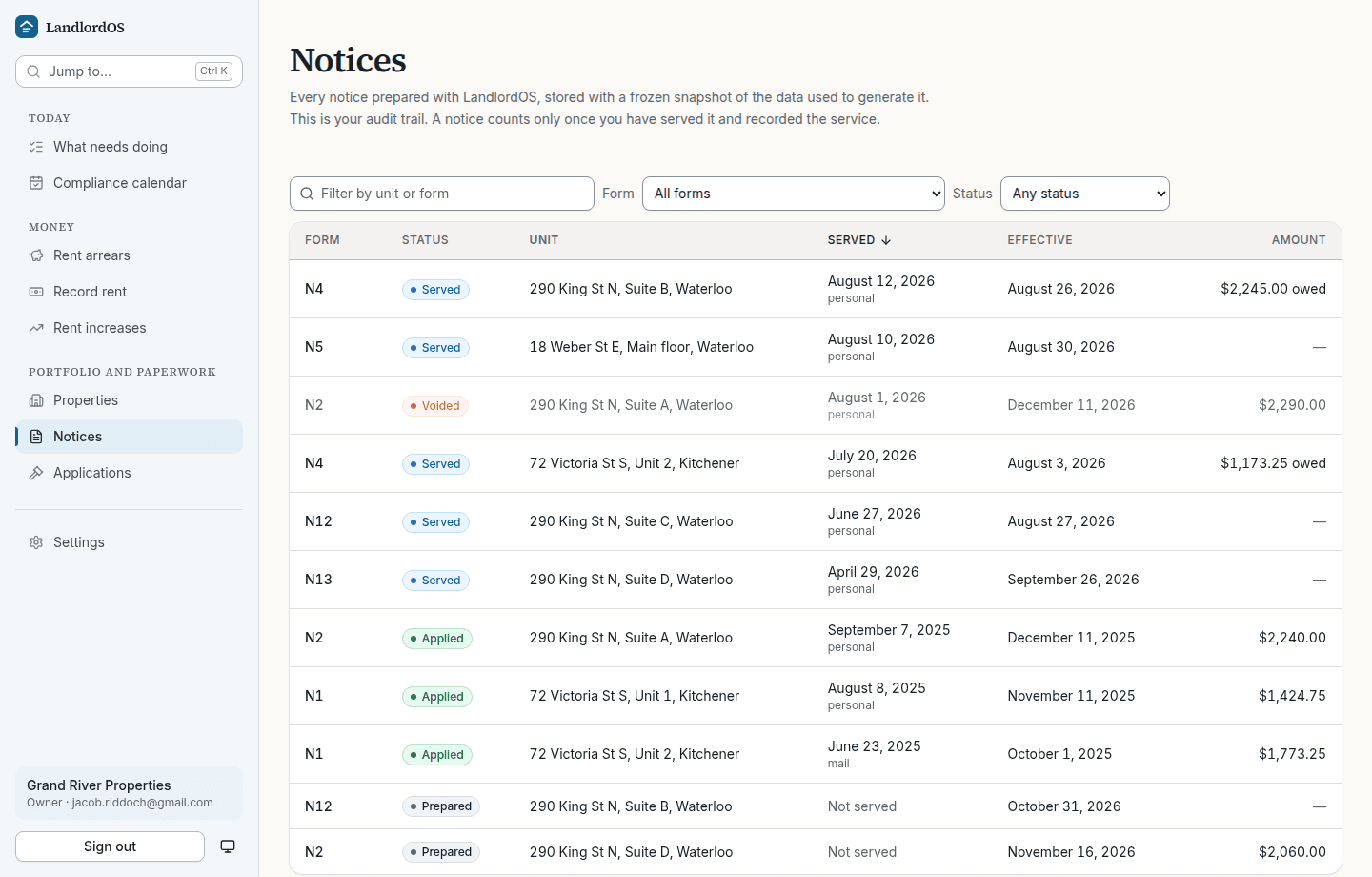
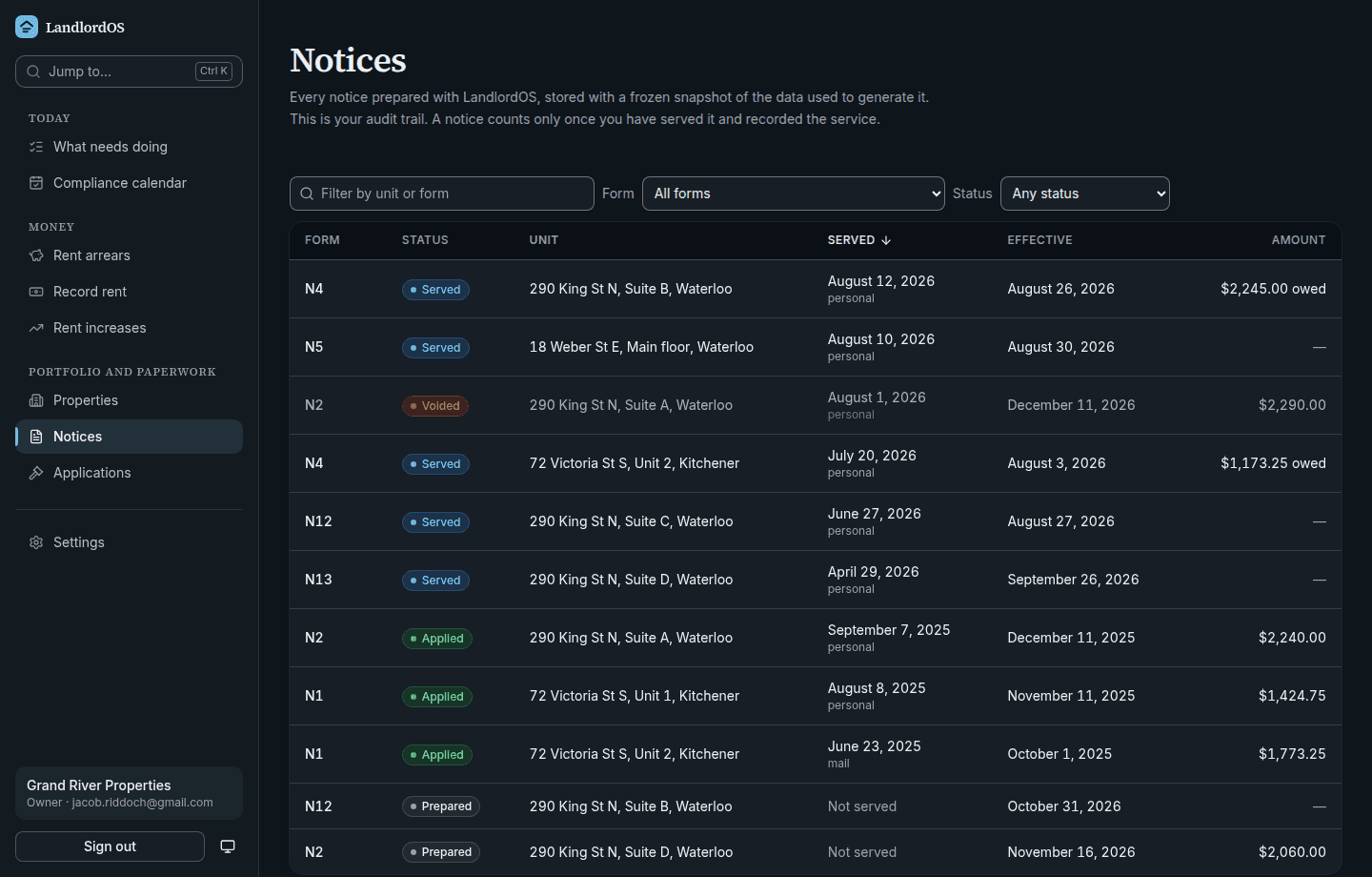
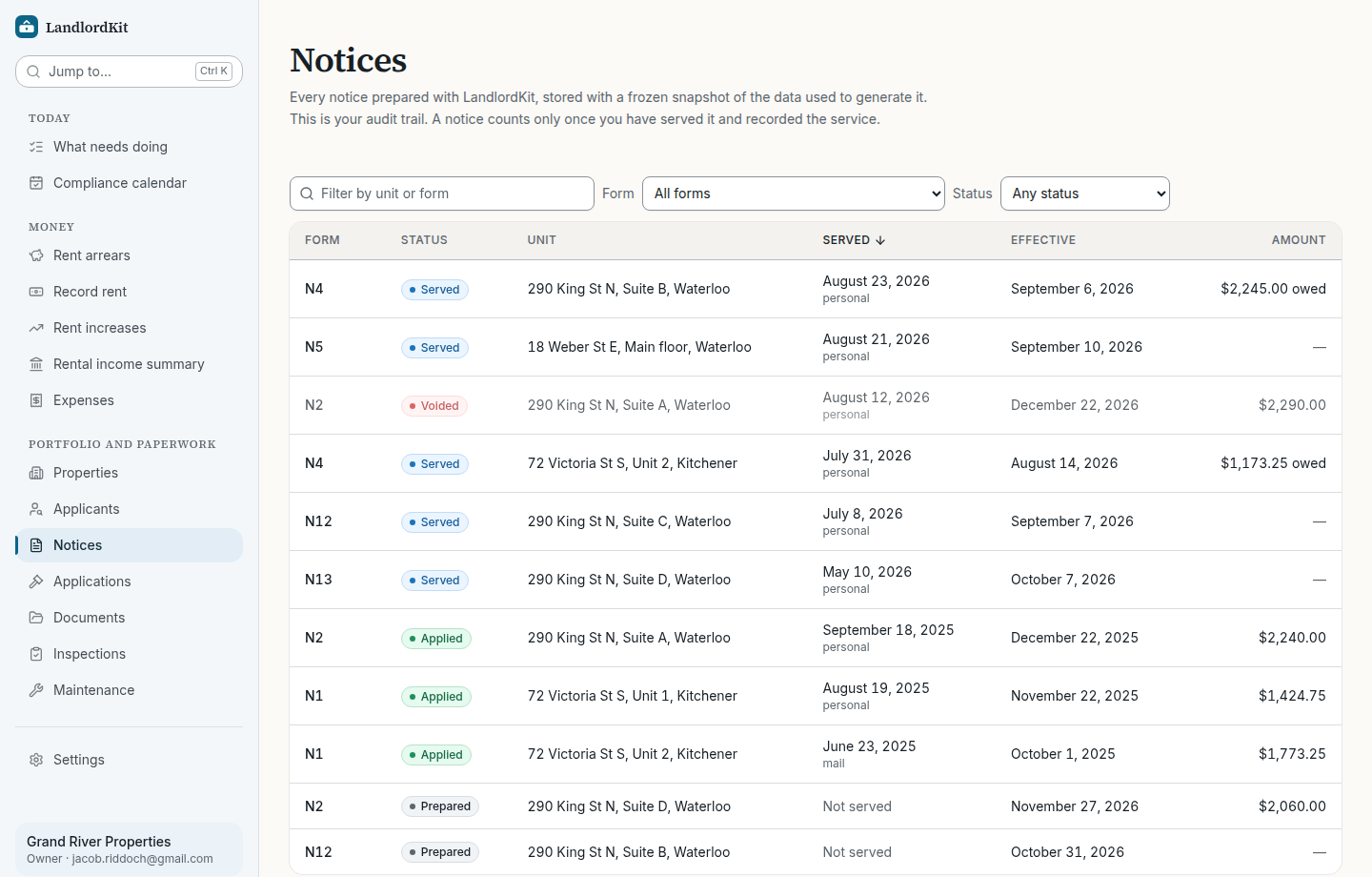
The audit trail: six forms across four states, each stored with the data it was generated from.
/product/notices-wide-light.pngReal capture of the seeded demo at 1440px. Fictional tenants, which is the only reason it may be published.
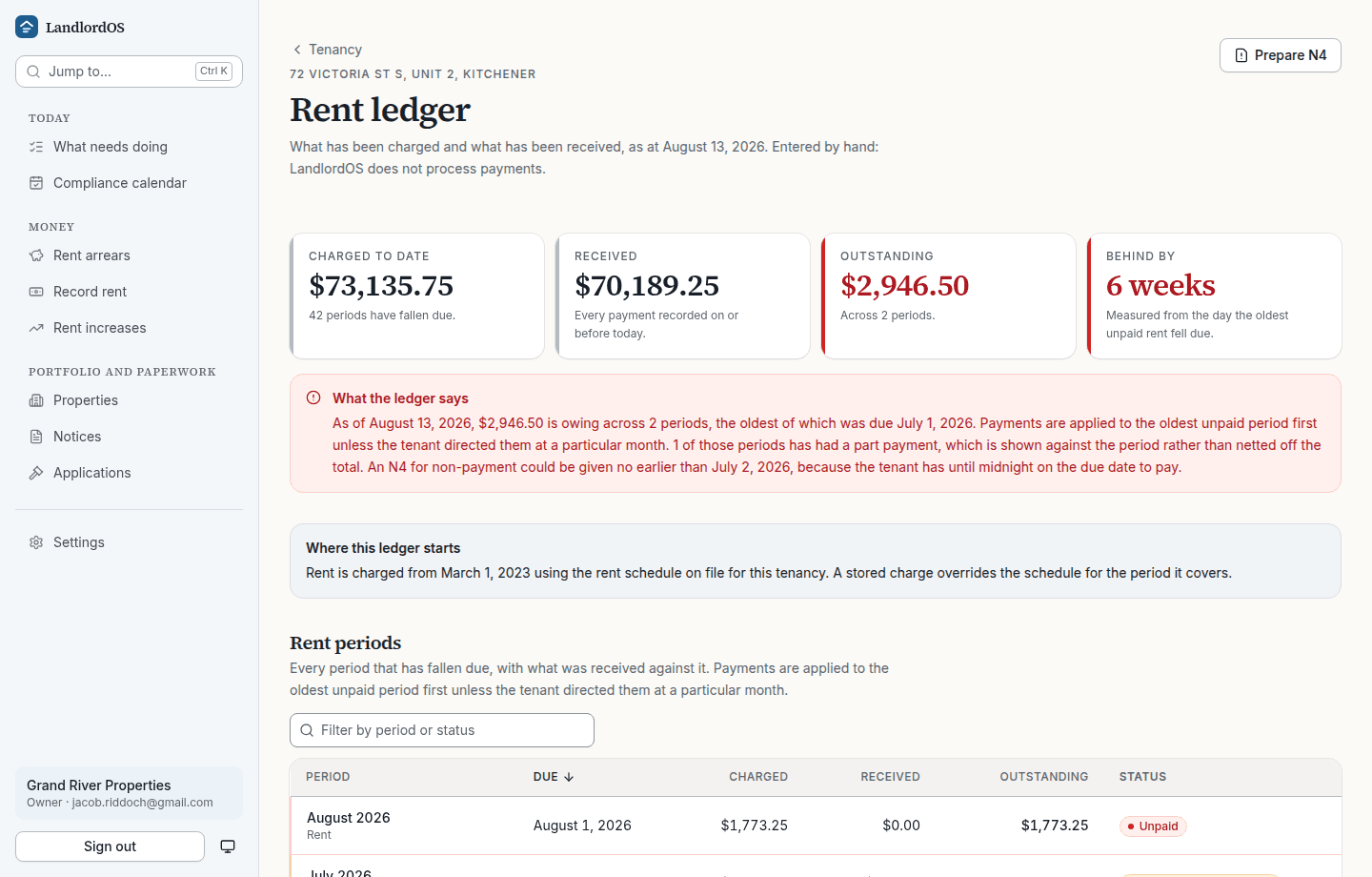
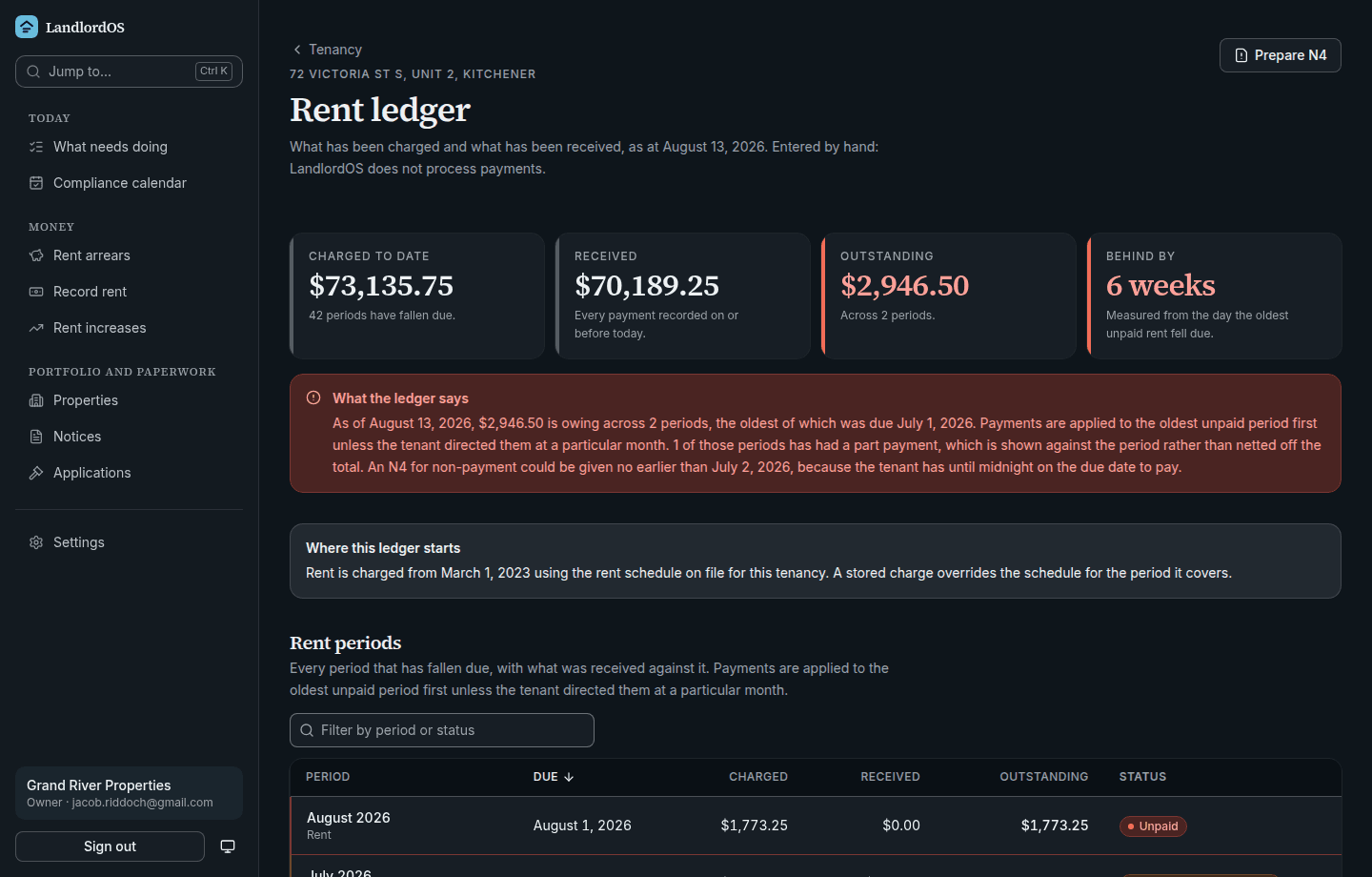
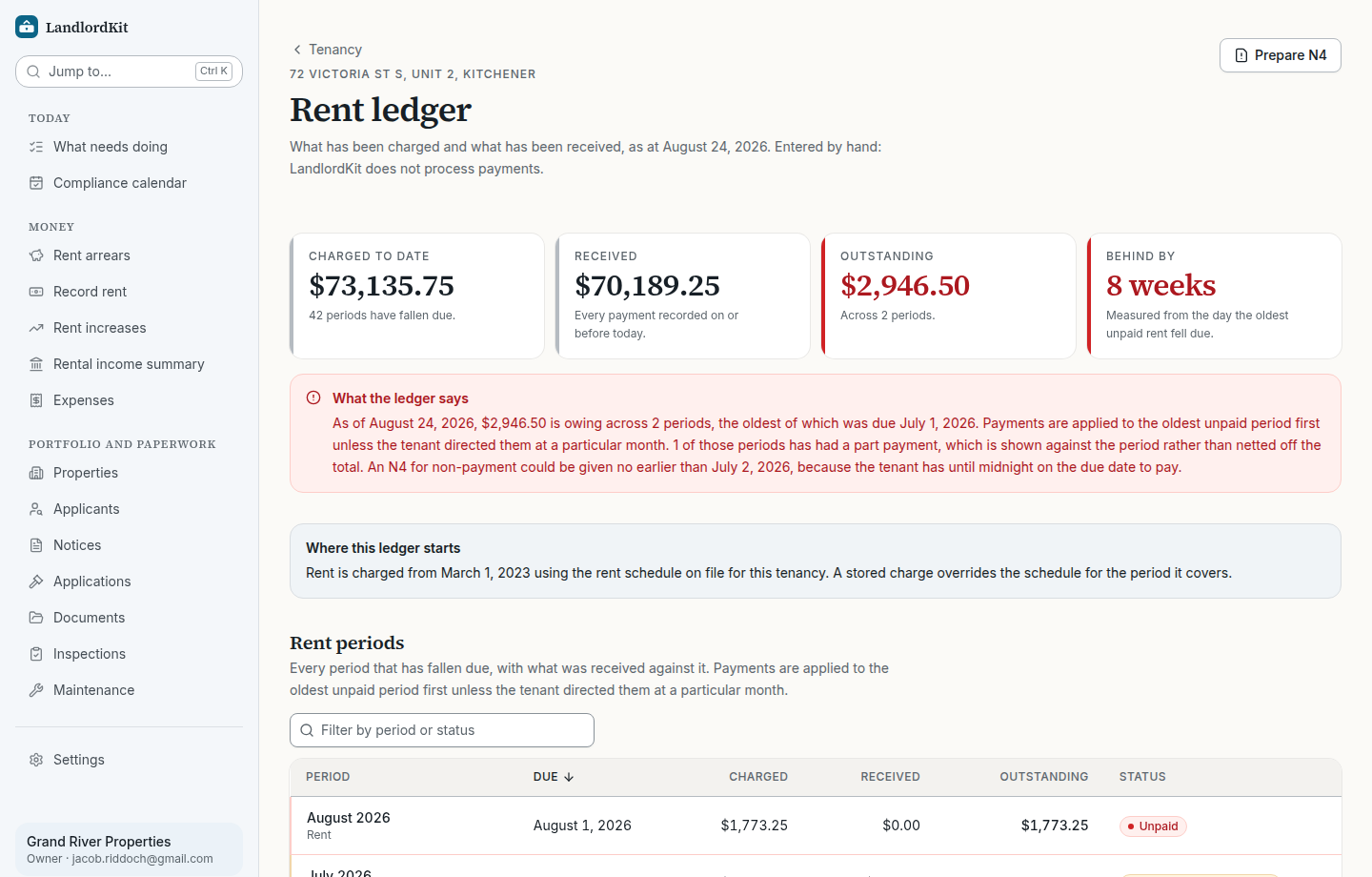
What was charged and what was received, with the arrears figure explained rather than asserted.
/product/ledger-wide-light.pngReal capture of the seeded demo at 1440px. Fictional tenants, which is the only reason it may be published.

Style
Writing the name, and the house rules
- One word, capital L and capital K: LandlordKit. Never LandLordKit, never Landlord Kit, never LLK.
- The domain is landlordkit.ca. It was LandlordOS until 2026-08-19 and infrastructure identifiers deliberately keep the old name, so a "landlordos" string in a log or a URL is not a typo.
- Never an em dash, in any copy. Commas, parentheses, colons or a sentence break. This applies to promotional writing exactly as it applies to the interface.
- Amounts are Canadian dollars and dates are en-CA. A price quoted without a currency reads as USD to half the internet.